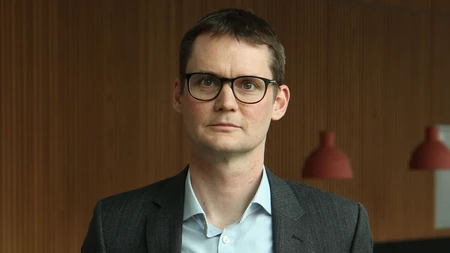
- Name:
- Richard Hayes
- Title:
- Chief Strategist, Transaction Banking
Sivua ei ole saatavilla suomeksi
Pysy sivulla | Siirry aiheeseen liittyvälle suomenkieliselle sivulleFrom “digital islands” to programmable payments. Nordea’s Ville Sointu breaks down what digital currencies actually mean for corporate treasury today. Based on our recent Treasury Trends webinar with Richard Hayes.

Digital currencies are no longer a distant concept for corporate treasurers. They are becoming an increasingly relevant topic as stablecoins and central bank digital currencies (CBDCs) move from pilot projects to mainstream conversation. But what problems are they actually trying to solve, and what does this mean for treasury in practice?
At their core, digital currencies aim to reduce friction and eliminate intermediaries in financial transactions. As Ville Sointu, Chief Strategist in Transaction Banking at Nordea, puts it: "Traditionally we have been living on digital islands." Blockchain and distributed ledger technology (DLT) emerged as a way to connect those islands, enabling atomic settlement, 24/7 availability, and programmable payments within a shared network or platform.
Understanding the differences between digital currency types is essential for any treasury professional:
The key question to ask, according to Sointu, is always: "A claim against whom?" – and what level of trust you place in that issuing entity.
Traditionally we have been living on digital islands.

For cross-border payments, stablecoins can outperform legacy correspondent banking, but only when acceptance is there on the receiving end. Today, most stablecoin transactions follow a "stablecoin sandwich" model: procure, send, convert back to fiat currency. This doesn't scale. The exception is in markets with volatile local currencies, such as parts of South America, where US dollar stablecoins are actively held and used, creating genuine secondary markets and real payment utility.
It is also worth noting that over 99.5% of the stablecoin market is currently denominated in US dollars, making the euro stablecoin an uphill battle for now. Nordea has nonetheless invested in Qivalis, a joint venture aiming to launch a regulated euro-denominated stablecoin under the EU's MiCA regulation.
For multinationals with already centralised liquidity management and automated payment processes, the honest answer is: the immediate upside is limited. The real benefits will come when tokenised deposit networks become interoperable, widely available, and capable of supporting conditional, programmable payments, including across time zones and on weekends.
Programmability, the ability to embed pre- and post-conditions directly into payment transactions, is a genuine opportunity for treasury. But as Sointu notes, this is not technology-dependent: "We can do programmable conditional payments today on a conventional database system." The harder question is agreeing on the rules, validation, and legal framework, challenges that remain largely unanswered even within DLT environments.
Digital currencies are maturing. The foundations are being laid. For treasurers, the question is no longer whether digital currencies are relevant, but how quickly the use cases will reach them.
Watch the on-demand Treasury Trends webinar with Ville Sointu and Richard Hayes.

The Corporate Insights newsletter sums up the top business insights and ideas from Nordea experts and beyond. The newsletter is for business leaders and professionals, ambitious entrepreneurs and for anyone who is interested in the latest financial developments.
Read moreMarkets and investment
Nordea analysts Josephine Cetti and Anders Svendsen share their key takeaways from Nordea’s webinar on the US midterm elections, and what the results mean for financial markets and the economy.
Read more
Sector insights
Sweden’s implementation of the EU’s revised Energy Performance of Buildings Directive (EPBD) changes how building energy performance is measured, rated and regulated, with real consequences for non-residential property owners.
Read more
Sustainability
Nordic companies remain firmly committed to addressing climate change and are delivering well on their Scope 1 and 2 emissions. However, our annual review of climate targets and progress across a universe of approximately 330 Nordic companies reveals a persistent gap between ambition and delivery on Scope 3 emissions.
Read more