Frank Vang-Jensen: ‘We want to position Nordea as the winner also beyond 2030’
3 min to read
On June 3, 2026, Nordea’s President and Group CEO Frank Vang-Jensen participated in a fireside chat at the BNP Paribas 2026 CEO Conference in Paris – a gathering bringing together leaders from across industries and geographies. The wide-ranging discussion covered several topics, including Nordea’s strategic priorities and its long-term investments in technology, efficiency and artificial intelligence.
The discussion opened with the uncertain global environment, including tensions in the Middle East. Vang-Jensen acknowledged that volatility has once again forced banks to reassess assumptions early in the year. “It’s a very unsettled world,” he said. Even so, he emphasised that Nordea sees “no direct threats” to its business and remains “well positioned and is performing well.”
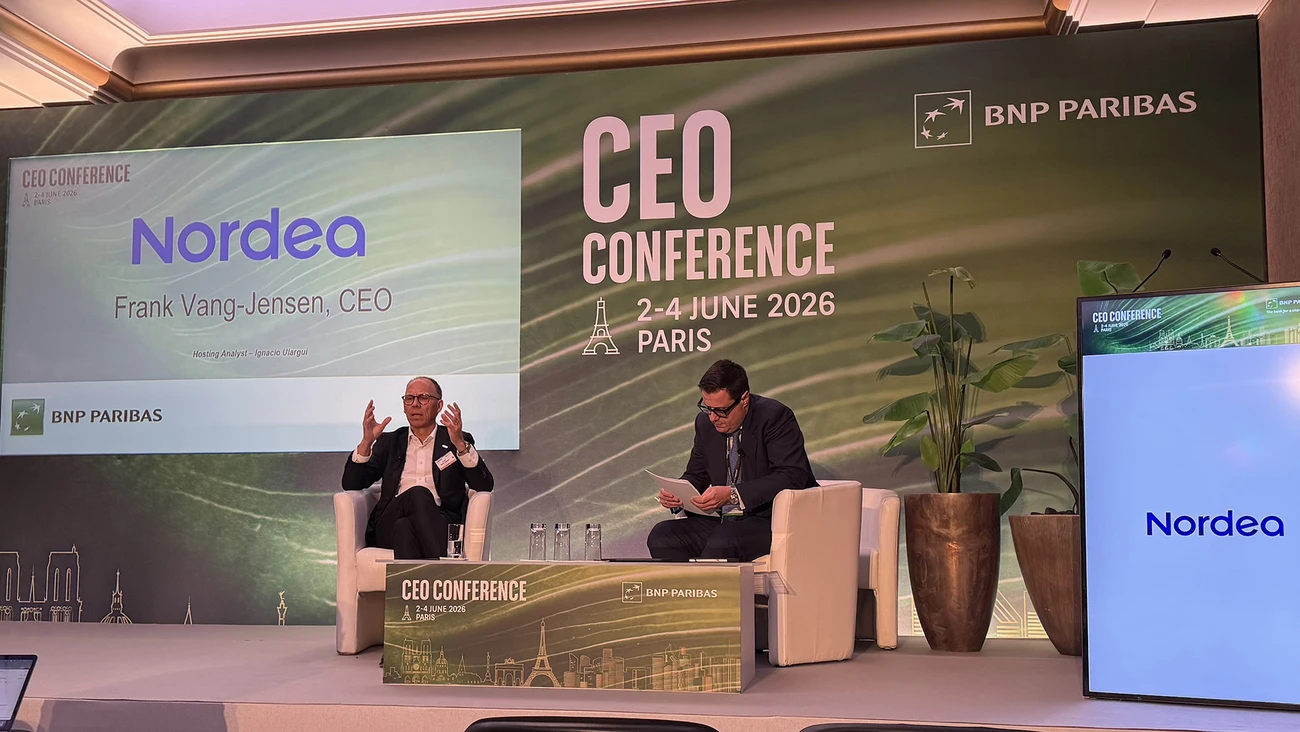
“Financial services is the place to be right now,” Vang-Jensen said, noting that economies are in the middle of a broad investment cycle – spanning growth, resilience and defence – where banks play a central role in financing and enabling progress across industries.
He said that Nordea’s confidence is also underpinned by its strong strategic plan. Launched in November last year, Nordea’s 2030 Strategy is designed to ensure the bank continues to outperform well into the next decade. “I do know that many [analysts] have a spreadsheet that goes three years out. But what we wanted to do was position Nordea to be the winner also beyond 2030.”
The plan targets strong growth and profitability, with Vang-Jensen reiterating ambitions for a return on equity “greater than 15% all the time, and significantly above in 2030.” At the same time, the Group is working to structurally improve efficiency, aiming to bring its cost-income ratio to 40–42%.
Despite the global uncertainty, Vang-Jensen said growth dynamics in the Nordics remain supportive, particularly on the corporate side. Household demand is still finding its footing, with activity picking up but at a more measured pace as customers adjust and confidence gradually returns. By contrast, corporate activity has strengthened clearly, he said, pointing to lending growth of 11% year-on-year in the first quarter.
Nordic companies are continuing to invest: “They have accepted it’s not the perfect situation…but they need to show growth and so they are investing in both inorganic and organic strategic initiatives.”
On net interest income, Vang-Jensen said the outlook had improved as policy rates stabilise after a period of declines. “We believe that the first quarter was the bottom [for NII on a daily basis],” he said, adding that volumes were supporting income, even as competition in the market remains high.
It’s not AI looking for a problem to solve. It’s us rethinking entire business processes.
A central theme of the discussion was Nordea’s ongoing evolution, particularly in technology and data. As part of its push to realise scale benefits, Nordea is moving toward a more integrated Nordic operating model, which would further reduce complexity and unlock efficiencies. This includes a significant simplification of systems and processes, with a target of notable cost savings over time.
Artificial intelligence is expected to play a growing role, but in a different way than initially anticipated. “We have learned a lot about AI,” Vang-Jensen said, adding that rather than pursuing only incremental use cases, Nordea is now driving AI as a more profound business transformation. “It’s not AI looking for a problem to solve. It’s us rethinking entire business processes.”
The approach is already being applied to areas such as mortgages and corporate lending, where automation and data-driven decision-making can enable better experiences for customers. As an example, Vang-Jensen said Nordea is working to automate 90% of mortgage loan promises by 2030.
Finally, Vang-Jensen stressed that Nordea’s sustained investment in digital capabilities would translate into clear competitive advantage. As digital adoption continues to increase and customers manage even more of their finances digitally, banks that fail to modernise would fall behind.
Some peers would see their market shares erode in traditional banking products. “It’s not because they don’t have the [products, the liquidity or the people]…it’s simply because their operating model doesn’t work anymore,” he said, adding that they have underinvested in digital technology and were still heavily branch-led.
The main competitors of Nordea in the future would be native digital and digital-first challengers.
“That game we want to win, and that is why we keep investing so much money in technology and have put out a strong plan to position Nordea as the winner in the long term."