Beklager...

Denne siden findes ikke på norsk

Bli værende på denne siden | Fortsett til en lignende side på norsk

Artificial intelligence is transforming financial services, improving customer experiences, strengthening security and increasing efficiency. At the same time, it is reshaping the threat landscape, forcing banks to rethink how they manage risk and protect trust.

For Kirsten Renner, trust is the central theme the industry faces.

"AI has the potential to make financial services safer, faster and more personal. But the same technology is also making fraud easier to scale and harder to detect. The defining question is not how quickly we adopt AI, but whether we can maintain trust while doing so," she says.

Scale brings responsibility

That challenge is particularly important for large financial institutions. Nordea serves millions of customers across the Nordic region and recorded 1.6 billion logins to its digital channels last year. Kirsten Renner stresses that operating at that scale brings both opportunities and responsibilities.

"Technology underpins services that people and businesses rely on daily. We have access to vast amounts of data and millions of customer interactions, which gives us a particular responsibility when introducing AI. Innovation must always go hand in hand with security, resilience and trust."

In financial services, accountability can never be delegated to an algorithm. AI helps identify risks, but it is humans who make judgements and take decisions.

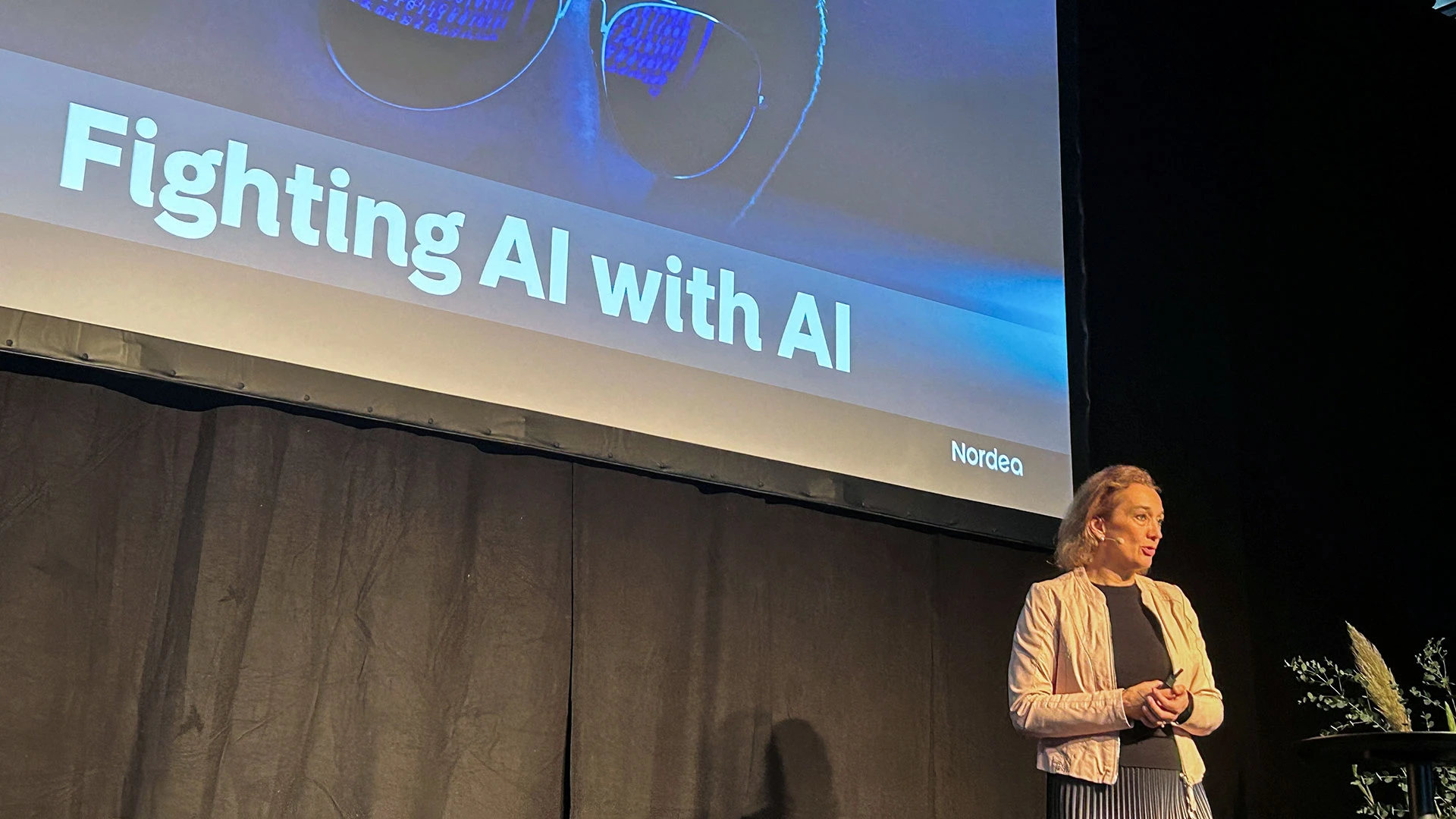
Fighting AI with AI

As AI becomes more powerful, it is changing both sides of the security equation. Banks are using AI to detect threats and identify risks more effectively, while criminals are using the same technology to create more convincing scams, deepfakes, phishing attacks and cyberattacks. Kirsten Renner explains:

"AI is making financial services smarter, faster and more tailored to customers’ needs and behaviour. At the same time, it is making fraud, cyber threats and impersonation more sophisticated. The same technology is making both defenders and attackers more effective. That is why defending against AI-generated attacks whilst deploying trustworthy AI safely at scale could become one of the industry's most important competitive advantages.”

The rise of AI is also transforming how financial institutions think about governance, oversight and risk management. Traditional rule-based approaches are now complemented by systems that identify patterns and anomalies that would otherwise go unnoticed.

Trust cannot be automated

“Trust is built long before an AI solution reaches a customer. It comes from strong governance, rigorous testing, clear accountability and responsible use of data. Customers do not need to understand every model we use, but they do need to trust the institution behind it. In financial services, accountability can never be delegated to an algorithm. AI helps identify risks, but it is humans who make judgements and take decisions,” she says. 

Looking ahead, Kirsten Renner believes resilience and collaboration will become increasingly important as AI adoption accelerates across the industry. Banks, regulators and authorities will need to work together to address threats that continue to evolve in scale and sophistication.

"We cannot protect customers against AI-enabled threats using yesterday's tools. If fraudsters use AI, banks must use AI better. But technology alone is not enough. Protecting customers requires strong cyber defence, greater awareness among people and effective communication. That is how the financial sector should collaborate to maintain trust. The future of financial services will not be defined by who deploys the most AI. It will be defined by who earns the most trust while doing so."
Fraud
Insights
After reading this article, is your perception of Nordea? (Required)
* Required fields are shown with an asterisk.
Nordic Fintech Week venue

Tech & AI

From innovation to scale: The next chapter of Nordic fintech

Nordic Fintech Week 2026 is in full swing, bringing together founders, investors, fintechs and financial institutions from across the region. As an official partner of the event and sponsor of the Nordic Fintech Awards, Nordea is helping celebrate the innovation and talent driving the future of financial services.

Read more
Lasse Karner

Business growth

Fraud is the fastest-growing form of organised crime. Is your company ready?

Lasse Karner, Fraud Prevention Expert, Nordea in Denmark, argues that fraud prevention is not a finance department issue – it is a board responsibility that runs from the top of the organisation to the frontline.

Read more
Stock market

Markets and investment

AI equities: Why the scepticism may be warranted

Despite AI’s rapid growth, Nordea’s Kirsti Sunde Midttun and Ole Håkon Eek-Nielsen see several challenges to profitability and present a more sceptical view of the industry’s prospects.

Read more