This article first appeared in the Nordea Economic Outlook: Northern Lights, published on 21 January 2026.
Read more from the latest Economic OutlookEconomic Outlook
Growing demand for NOK
Movements in the NOK exchange rate are closely tied to structural net NOK transactions. After several years of persistent negative pressure, in which many market participants had an underlying need to sell NOK, we are now seeing signs of a shift in main flows, indicating a gradual strengthening of the NOK in 2026.

Market participants trade NOK in the foreign exchange market every day, yet there is no comprehensive overview of all these transactions. To understand the long-term drivers behind the NOK exchange rate, we compiled a dataset covering the largest market participants that we can reliably track: Norges Bank, oil and gas companies, life and pension companies, foreign direct investments (FDI) and the mainland trade balance.
In principle, purchases and sales of NOK should always balance in size. The key factor for the exchange rate is not gross volumes but whether there is a persistent net need to buy or sell NOK over time. Our analyses indicate that shifts in these net flows, rather than their level, drive the NOK exchange rate. Fluctuations in the sum of structural NOK transactions have largely tracked EUR/NOK since 2008 – with the pandemic in 2020 as a clear exception.
After many years of negative underlying pressure, it appears that the balance in the NOK market is starting to tilt in a more positive direction.
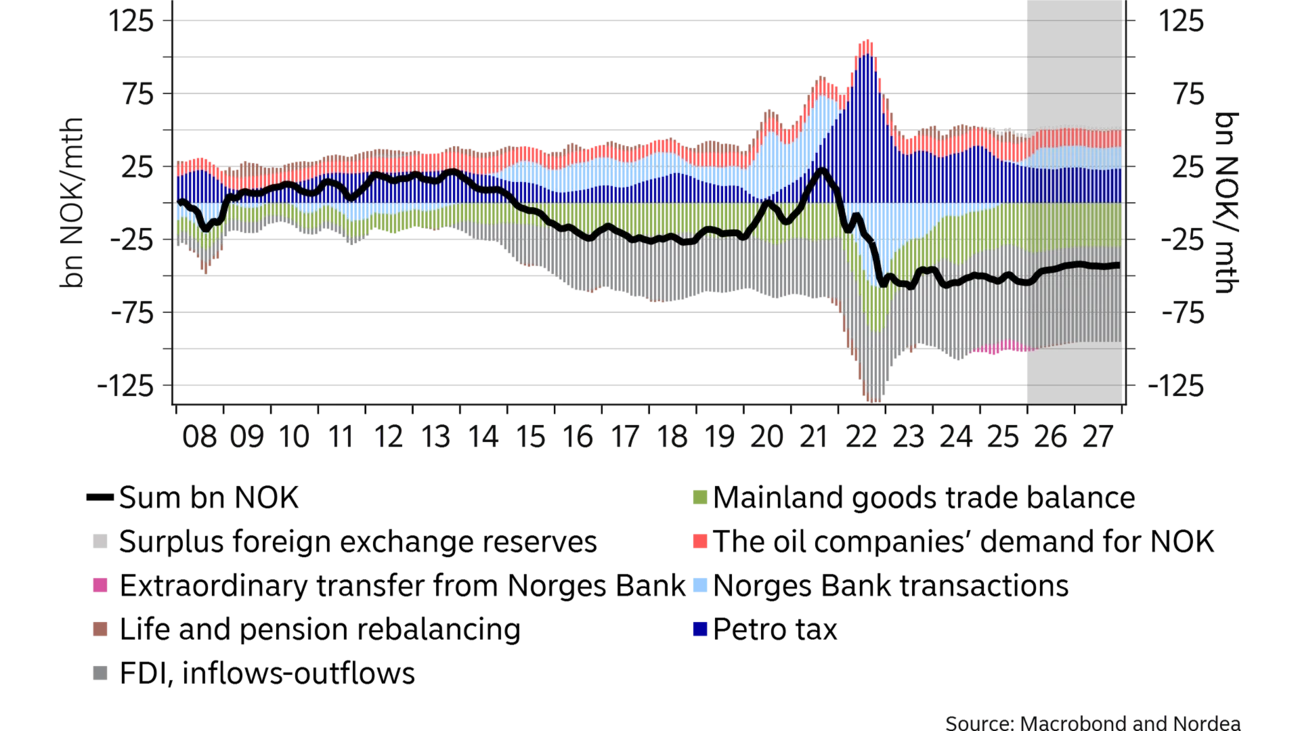
After 2014, several structural factors have contributed to weakening the NOK. Net FDI have become increasingly negative, as Norwegian companies invest more abroad than foreign investors do in Norway. At the same time, the mainland trade balance has become more negative, primarily as a result of increased import volumes. In 2022, the NOK faced further headwinds when Norges Bank shifted from being a net buyer to a significant net seller, while life and pension companies sold NOK to maintain stable currency hedge ratios amid falling asset prices.
A / Net NOK transactions distributed on market participants
Several structural factors have weakened the NOK over time
B / Net NOK transactions and EUR/NOK
EUR/NOK tracks the development in net NOK transactions
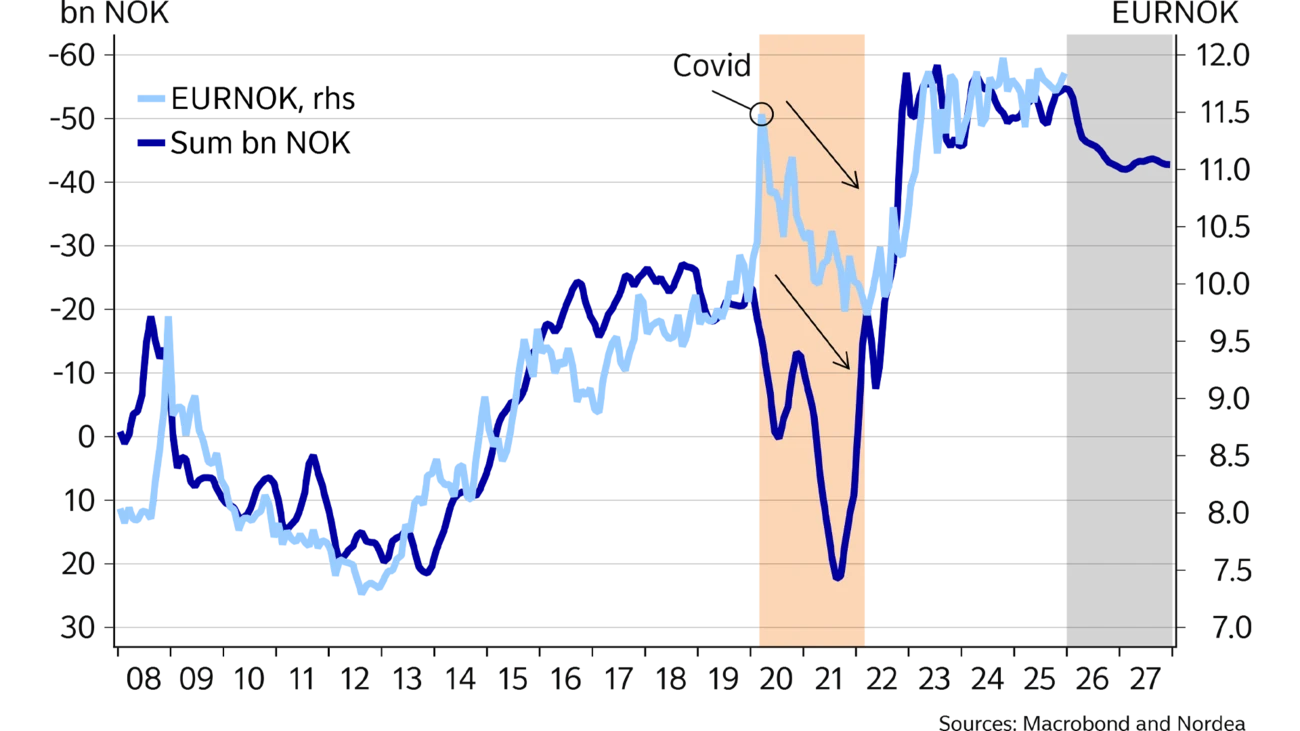
Since 2023, these net flows have been relatively stable, and EUR/NOK has largely moved sideways. However, for 2026, the picture looks different. Based on current forward prices, we estimate that oil and gas companies’ tax payments will fall this year. Meanwhile, state revenues from the petroleum sector will be lower than the estimated oil-adjusted budget deficit. This means Norges Bank will have to buy a substantial amount of NOK to cover the oil-adjusted budget deficit for this year. Norges Bank will thus shift from being a net seller of NOK to a net buyer. In December, Norges Bank announced that it will buy NOK 776m every day throughout January (see Chart A). Overall, the changes in the most important structural currency flows indicate that the NOK will strengthen somewhat in 2026. After many years of negative underlying pressure, it now appears that the balance in the NOK market is starting to tilt in a more positive direction.
Authors

- Name:
- Kjetil Olsen
- Title:
- Chief Economist, Norway

- Name:
- Sara Midtgaard
- Title:
- Senior Strategist
Get the Economic Outlook delivered to your inbox
Sign up for the Nordea Economic Outlook
Stay ahead of the curve with our expert economic insights and forecasts. Get the latest analysis on global and Nordic markets delivered straight to your inbox.
Read more
Economic Outlook
Norwegian economy: Moderate outlook
The Norwegian economy has picked up but has recently been slightly weaker than estimated. While many areas of the economy are doing well, others are more challenging.
Read more
Economic Outlook
Nordea Economic Outlook 2026: What lies ahead?
Join us for the release of the Nordea Economic Outlook on 21 January. Register for our webinar featuring Nordea’s Group Chief Economist Helge J. Pedersen, who will provide an in-depth look at Nordea’s latest economic forecasts.
Read more
Economy
Chief Economist's Corner: Welcome to 2026
The global economy proved to be more resilient to President Trump's aggressive trade policy than many feared. This provides the basis for a tempered – but real – optimism as we enter the new year.
Read more