Anteeksi...

Sivua ei ole saatavilla suomeksi

Pysy sivulla | Siirry aiheeseen liittyvälle suomenkieliselle sivulle

Danish companies have quietly become some of Europe’s most prolific acquirers. In 2024, they led Nordic M&A activity in absolute terms – and arguably on a per capita basis too. While names like Novo Nordisk, Genmab, Carlsberg and DSV all feature, the pharmaceutical sector stands out. For Denmark, pharma has become something of what the Magnificent Seven tech companies are for the US.

Lundbeck is a case in point. The brain health company has pursued a disciplined and ambitious growth strategy, culminating in the landmark acquisition of Longboard Pharmaceuticals in 2024.

Why Danish pharma is buying

Several structural factors have converged to make Danish pharma companies natural acquirers. Strong balance sheets, low leverage levels and robust cash generation have created financial firepower. Strategy demands more than organic growth alone. In an industry where patent cliffs and loss of exclusivity are constant factors, M&A and partnerships have become essential tools for protecting and reshaping pipelines.

Lundbeck's ownership structure adds another dimension. With the Lundbeck Foundation holding close to 70% of the company, there is a long-term, strategically engaged shareholder backstopping major decisions. 

"Having a strong shareholder with a long-term perspective is really supportive in this kind of transformation," says Peter Kreutzfeldt, Head of Group Treasury and Insurance at Lundbeck.

We moved from trying to cater our funding platform for where we are now, to asking how we can best support the strategy and the growth journey.

Peter Kreutzfeldt, Head of Group Treasury and Insurance at Lundbeck

Building a funding platform for scale

A decade ago, Lundbeck's treasury function was less mature, relying on bilateral bank deals. The company’s journey since then mirrors a pattern seen across ambitious corporates: from bilateral arrangements to club deals, then syndicated facilities and ultimately bond market access supported by a credit rating, according to Immelborn. The pivotal shift came around 2019-2020, when Lundbeck obtained an investment grade rating, established an EMTN (euro medium-term note) programme and issued its first bond. 

"We moved from trying to cater our funding platform for where we are now, to asking how we can best support the strategy and the growth journey," says Kreutzfeldt.

More recently, Lundbeck has embraced bridge financing as a tool for deal execution, a structure that places significant reliance on relationship banks.

Certainty of funds as a competitive advantage

In competitive M&A processes, demonstrating financing certainty is itself a differentiator. "It's about sending a clear signal that financing is not going to be the reason this transaction fails," says Kreutzfeldt. By including bank underwriting in its toolbox, Lundbeck has added a strong option for removing financing risk from the equation.

With strong balance sheets, a clear strategic rationale and a maturing funding infrastructure, the conditions for continued M&A activity across Danish pharma remain firmly in place – and Lundbeck has built the platform to act when the right opportunity arises.

Lundbeck’s M&A strategy

Lundbeck’s M&A strategy is closely anchored in its broader strategic focus on innovation in neuroscience, particularly in areas of significant unmet patient need within rare and specialist-treated neurological disorders. The company targets selective acquisitions that can complement its existing pipeline assets and in-market strategic brands, while leveraging the commercial, medical and development capabilities built around them. This ability to integrate new assets into an established value chain can create meaningful synergies, providing a potential competitive advantage in M&A negotiations and generating benefits for both patients and shareholders. 

At the same time, Lundbeck applies a disciplined approach to capital reallocation, with clear return requirements designed to ensure that M&A activities contribute to value creation over both the short and long term.

Learn more about Lundbeck's strategy
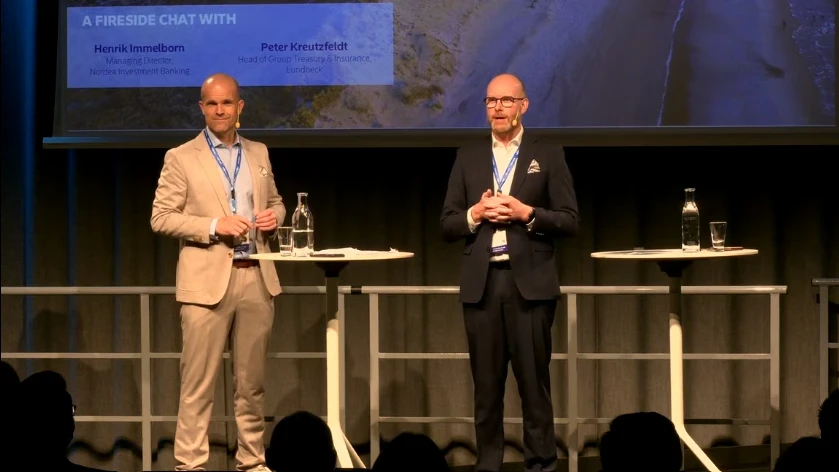

Fireside chat at Treasury 360 Nordic 2026 with Peter Kreutzfeldt, Head of Group Treasury and Insurance at Lundbeck (left) and Henrik Immelborn, Head of Debt Solutions and Loans Denmark at Nordea (right). Photo credit: Treasury 360
After reading this article, is your perception of Nordea? (Required)
* Required fields are shown with an asterisk.
Electric bus charging

Sector insights

The Nordic transition in commercial vehicles: Momentum builds, but adoption remains slow

The transition of Nordic commercial transport towards lower emissions is clearly underway, but it still lags passenger transport. Tightening regulation, low Nordic electricity prices and improving technology are pushing the sector toward electrification, despite significant investment requirements.

Read more
Linda Ågren, Head of Large Corporates & Institutions Sweden, Nordea

Meet our experts

Meet our people: Linda Ågren on drive, trust and why AI won’t replace relationships

From archery to banking, her drive has always been there. As head of Nordea’s Large Corporates & Institutions Sweden, she reflects on what it means to be a trusted financial partner in an unpredictable world.

Read more
Chef serving burgers in the kitchen

Chief Economist's Corner

Chief Economist's Corner: Burgernomics in practice

From Tokyo to Tivoli: What the price of a burger reveals about exchange rates and purchasing power.

Read more