
- Name:
- Richard Hayes
- Title:
- Chief Strategist, Transaction Banking
Siden findes desværre ikke på dansk
Bliv på siden | Fortsæt til en relateret side på danskThe Supreme Court’s decision to overturn IEEPA tariffs marks a shift in US trade policy, moving from unpredictable emergency measures to a more structured, longer-term elevated tariff environment that will reshape global trade relationships.

The recent US Supreme Court decision to overturn President Trump’s tariffs under the International Emergency Economic Powers Act (IEEPA) has fundamentally reshaped US trade policy. As we highlighted during a recent Trade Trends webinar, this represents a shift towards a more predictable but elevated tariff environment that companies must navigate strategically.
In February 2026, the Supreme Court struck down the IEEPA tariffs that had generated around USD 27 billion monthly (USD 320 billion annually) for the US Treasury. The court ruled that Congress alone has the constitutional authority to “lay and collect taxes,” including import tariffs, limiting the President’s ability to use IEEPA as a framework for tariff implementation.
This decision doesn’t eliminate tariffs entirely but forces the administration to pursue alternative legal authorities. Treasury Secretary Scott Bessent immediately announced plans to use Section 122, 232 and 301 protocols to maintain revenue levels broadly similar to IEEPA.
The administration has implemented a structured approach to replace the overturned tariffs:
Phase 1: The bridge period (February-July 2026)
A 150-day window featuring a flat 10% global tariff under Section 122 authority. This represents an effective tariff rate of 10.5%, the highest since 1943. The bridge includes carve-outs for US-Mexico-Canada Agreement (USMCA)-compliant goods and products that cannot be produced domestically.
Phase 2: The future framework
Section 301 tariffs will replace the temporary measures. Unlike Section 122, these tariffs are uncapped, not time-bound and can be country-specific. Unlike the IEEPA tariffs, they can’t be turned on and off as part of the administration’s dealmaking process with countries.
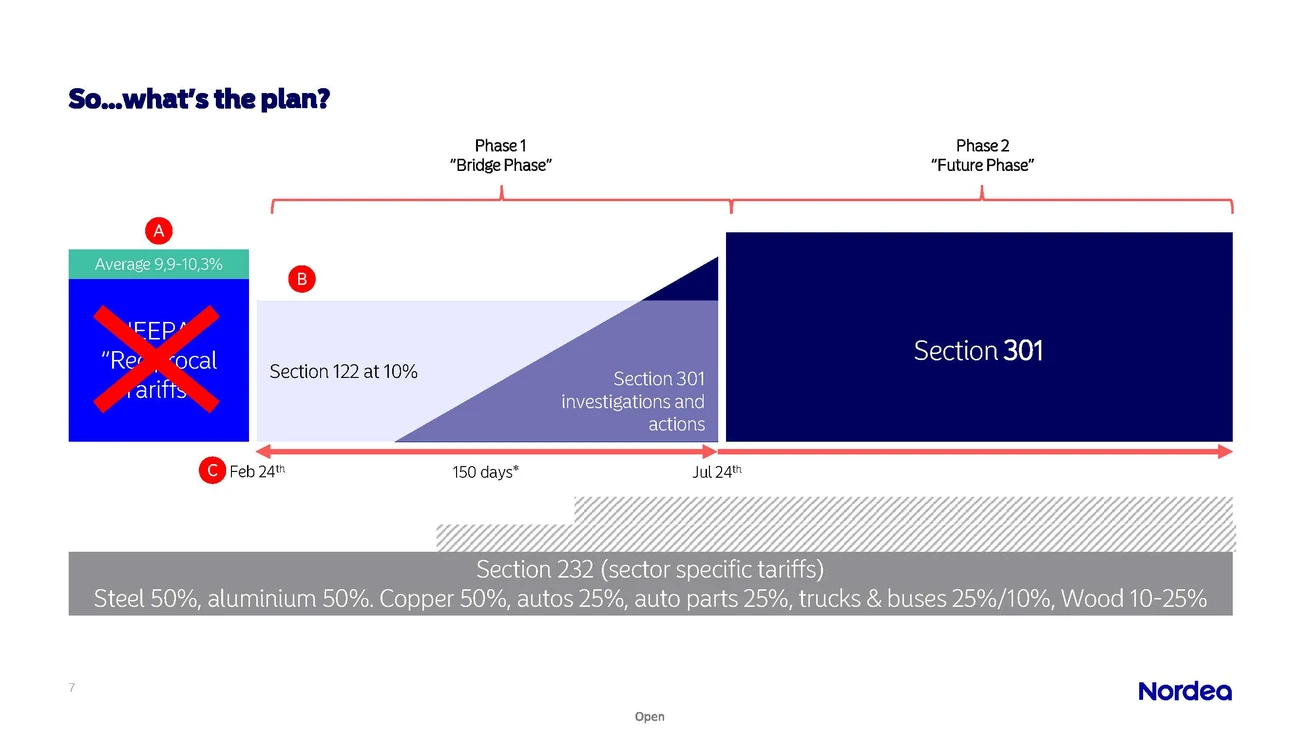
Two comprehensive Section 301 investigations are targeting over 60 of America’s largest trading partners, including the EU, Norway, China, Japan, Korea, India and others:
These investigations are running on an accelerated timeline to ensure new tariffs are ready when the Section 122 bridge expires in July.
The shifts provide greater predictability than the previous IEEPA framework. Section 232 and 301 tariffs are well-established, tested mechanisms that offer more clarity for long-term planning given their “sticky” nature. Once implemented, they typically remain in place for years.
These changes represent a longer-term shift rather than temporary measures. Historical data shows that tariff revenues increased from USD 4.7 billion monthly under the first Trump administration to USD 7.1 billion under Biden, demonstrating bipartisan support for protectionist trade policies.
Key factors supporting this permanence include:
Watch a recording of the Trade Trends webinar, "Tariffs on trial: What's next for US trade policy?"

The Corporate Insights newsletter sums up the top business insights and ideas from Nordea experts and beyond. The newsletter is for business leaders and professionals, ambitious entrepreneurs and for anyone who is interested in the latest financial developments.
Read more
Sustainability
Following extensive industry feedback, the European Commission is proposing clarifications to the EU Taxonomy’s Climate Delegated Act to make compliance more practical and consistent across sectors. The draft changes are open for consultation until 14 April, with implementation expected from 1 January 2027.
Read more
Tech & AI
The financial industry is changing fast. Economic uncertainty, digital innovation and stricter regulation combined with climate, demographic and cyber challenges redefine how institutions compete and create value. Let us walk you through eight key trends.
Read more
FX
Ten years ago, Nordea built AutoFX with a large global corporate, driven by a simple vision: to help corporate treasuries automate daily FX tasks. Today, as we celebrate this milestone, we’re witnessing a shift in how companies approach treasury automation – moving from operational efficiency to strategic enablement.
Read more