- Name:
- Richard Hayes
- Title:
- Chief Strategist, Transaction Banking
Den här sidan finns tyvärr inte på svenska.
Stanna kvar på sidan | Gå till en relaterad sida på svenska4 min to read
This article is based on our recent Trade Trends webinar with Richard Hayes, in which he explored what shifts in global shipping can tell us about the future of trade and the implications for treasury and working capital.
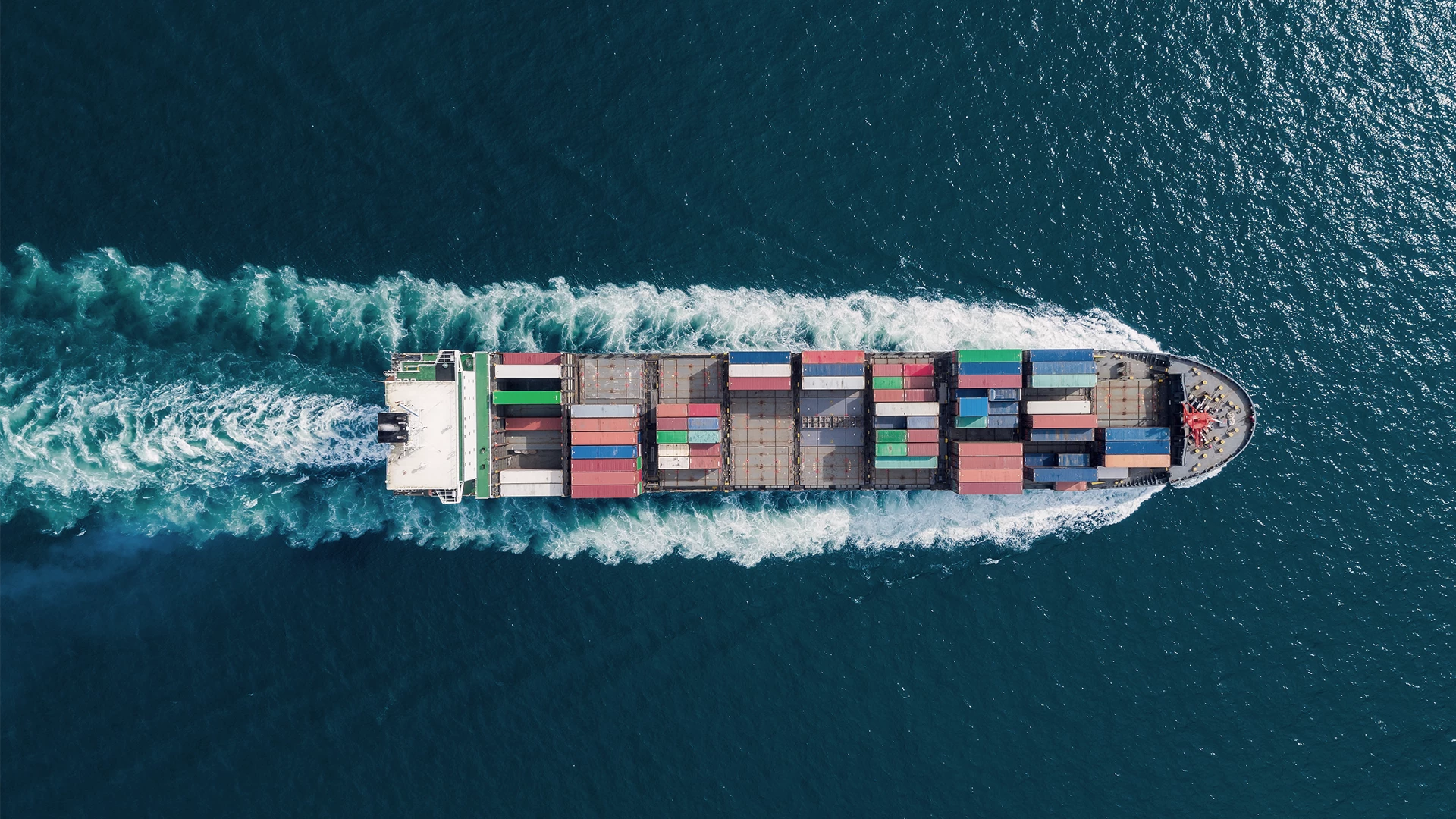
When we talk about trade disruption, the conversation quickly turns to tariffs, geopolitical tension and trade negotiations. But there is another story unfolding, one that begins on the water. Shipping is where disruption becomes visible first, long before it shows up in trade statistics or corporate balance sheets.
With 90% of world trade moving by sea, shipping companies make daily decisions about routes, capacity, pricing and risk. Those decisions are an early warning system, and right now, they are signalling something important.
Despite an extraordinary sequence of shocks over the past five years, including COVID-19, the war in Ukraine, attacks on Red Sea shipping, Panama Canal restrictions and rising global fragmentation, world trade has proven remarkably resilient. Volume data shows that while COVID caused a sharp drop and rebound, the long-term growth trend has remained broadly intact.
But resilience does not mean stability. Trade growth has slowed slightly, volatility in import and export flows has increased, and the nature of trade itself is changing.
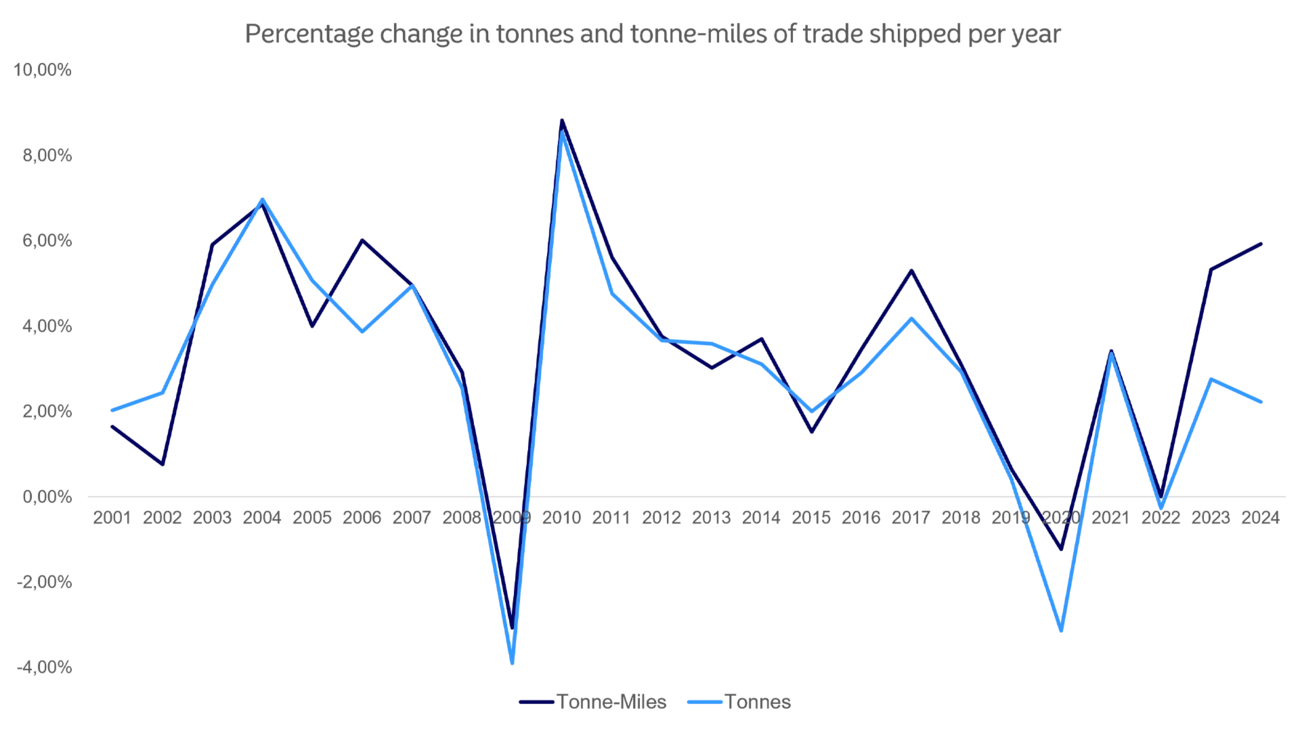
For decades, trade has been measured primarily in volume. But a more telling metric is now emerging: tonne miles, or the distance a tonne of cargo travels. UN Trade and Development (UNCTAD) data shows tonne miles growing significantly faster than trade volumes since 2022. Cargo is travelling farther as ships reroute around conflict zones, supply chains diversify, and energy flows shift.
This has direct implications for working capital. Longer journey times mean more inventory in transit, greater forecasting uncertainty and potentially higher financing requirements. Geography is becoming a balance sheet issue, and a shipping disruption has the potential to create a working capital challenge for the supplier, buyer and sometimes both parties, depending on the point at which title and risk transfer occurs.
Route changes that were once purely a logistics matter are increasingly becoming commercial negotiation topics. A key question to ask is: Whose balance sheet is carrying the inventory while it’s on the water?
Disruption is also creating new trade flows. Corridors between Africa and Southeast Asia, between GCC (Gulf Cooperation Council) countries and India, and Mexico's growing role as a manufacturing hub for North American supply chains are all expanding. Trade is becoming more regionalised – not the end of globalisation, but a reorganisation around regional hubs and corridors.
The most significant shift may be in the role of treasury itself. Where treasury once focused on cash and risk management, it is now evolving into a strategic resilience function. It’s managing supply chain risk, funding risk, and inventory risk in an environment where freight rate volatility, as UNCTAD has noted, is becoming the new normal.
The parallel with shipping is instructive. Just as shipping companies are building route redundancy and capacity buffers, treasury teams need to build funding redundancy and diversify working capital sources. Trade finance and supply chain finance sit at the centre of this evolution.
Trade will continue to grow. Its shape will change. And the organisations best placed to benefit will be those whose treasury functions are already thinking like shipping companies, planning not just for the most efficient route, but for every route they might need.

The Corporate Insights newsletter sums up the top business insights and ideas from Nordea experts and beyond. The newsletter is for business leaders and professionals, ambitious entrepreneurs and for anyone who is interested in the latest financial developments.
Read more
Markets and investment
Despite AI’s rapid growth, Nordea’s Kirsti Sunde Midttun and Ole Håkon Eek-Nielsen see several challenges to profitability and present a more sceptical view of the industry’s prospects.
Read more
Markets and investment
The article is based on Nordea's latest quarterly Rates and FX webinar, in which economists Jan Størup Nielsen and Samir Barki reviewed the key trends in financial markets and presented Nordea's forecasts for the remainder of 2026.
Read more
Chief Economist's Corner
Public debt has risen dramatically in many countries since the financial crisis, and even more so since the pandemic. But borrowing is no longer free. This could lead to serious problems in the years ahead – though fortunately not in Denmark.
Read more