Get the latest insights on the economy, industries and emerging trends that can help your business tackle the challenges it faces in today’s market. We share the learnings and perspectives of leading experts and innovators in the Nordics, both from Nordea and beyond.
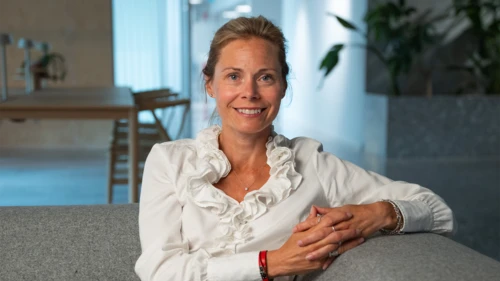
Meet our people: Linda Ågren on drive, trust and why AI won’t replace relationships
From archery to banking, her drive has always been there. As head of Nordea’s Large Corporates & Institutions Sweden, she reflects on what it means to be a trusted financial partner in an unpredictable world.
Finland’s long period of weak productivity growth finally appears to be easing. Part of the turnaround reflects a better cyclical backdrop, but the drivers of longer-term productivity growth have also strengthened.
Growth has picked up pace and economic conditions have normalised. The labour market is following suit, and with continued stable growth, resource utilisation will run slightly above normal next year.
A symmetric band around the central parity in Denmark
Previously, the Nationalbank was most inclined to keep the krone below the central parity. In recent years, however, it has allowed a greater weakening of the krone than before.
The Finnish economy has grown broadly in the first half of the year. Growth has been seen in private consumption, investment and exports alike. We expect growth to continue despite higher fuel prices and interest rates caused by the Middle East crisis. The recovery is expected to pass through to the labour and housing markets with a lag.
Despite higher energy prices and geopolitical uncertainty, the Danish economy continues to grow at a solid pace. The pharmaceutical industry remains the key driver of growth, but momentum is now also broadening to other parts of the economy.
Chief economist: Nordic economies continue to show strength
The global economy is demonstrating remarkable resilience in the face of geopolitical conflict, elevated energy prices and trade tensions. The US dollar is depreciating, while the Nordic economies continue to outperform.
The Swedish economy has normalised. Resource utilisation is currently at the historical average and should continue to rise over the coming year. Growth is being driven by both stronger exports and firmer domestic demand.
US technology stocks have delivered very strong returns in recent years, both in absolute terms and relative to other markets. This has contributed to a strong dollar. However, the path to profitability for AI-related companies remains unclear. A sharp decline in the US equity market could lead to a significantly weaker dollar.
Underlying inflation is likely to pick up again after its summer decline and remain around 3% through year-end. Inflation is therefore still where it was two years ago, while unemployment remains low.