More from the Economic Outlook
This article first appeared in the Economic Outlook: Resilience in motion, published on 2 September 2026.
Read more from the latest Economic Outlook2 min to read
Denmark's fixed exchange rate policy is set in stone. Beneath the surface, however, a shift has taken place in recent years to the Nationalbank's reaction function. Previously, the Nationalbank was most inclined to keep the krone below the central parity. In recent years, however, it has allowed a greater weakening of the krone than before. This stance is underpinned by confidence that the fundamental balances of the Danish economy rest on an exceptionally strong foundation.
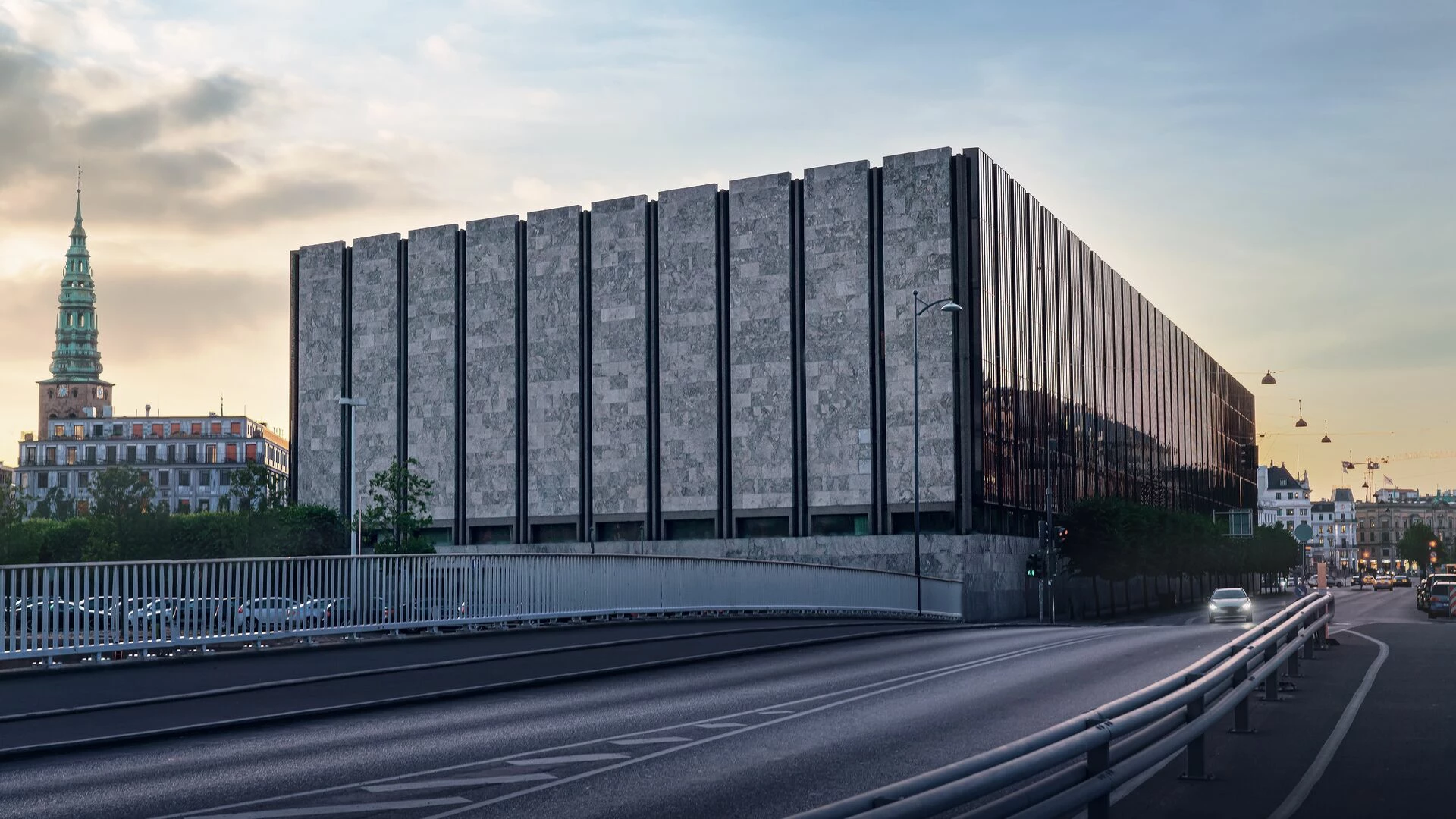
Since 1982, Denmark has pursued a fixed exchange rate policy. At that time, the Danish krone was pegged to the German Deutsche Mark. With the introduction of the euro, Denmark formally joined the ERM II cooperation in 1999, which typically serves as a stepping stone for countries on their way into the euro area. However, after euro membership was rejected in a referendum in 2000, Denmark chose to remain in ERM II.
Within this cooperation, the krone may officially fluctuate +/- 2.25% around the central parity of 7.46038 against the euro. Unofficially, however, the Nationalbank has chosen to maintain the krone within a much narrower range. This has been done out of a desire to preserve strong credibility in the defence of Denmark's fixed exchange rate policy – both to ensure a high degree of predictability regarding the krone's value against the euro and to minimise the risk of speculative pressure against the fixed exchange rate policy.
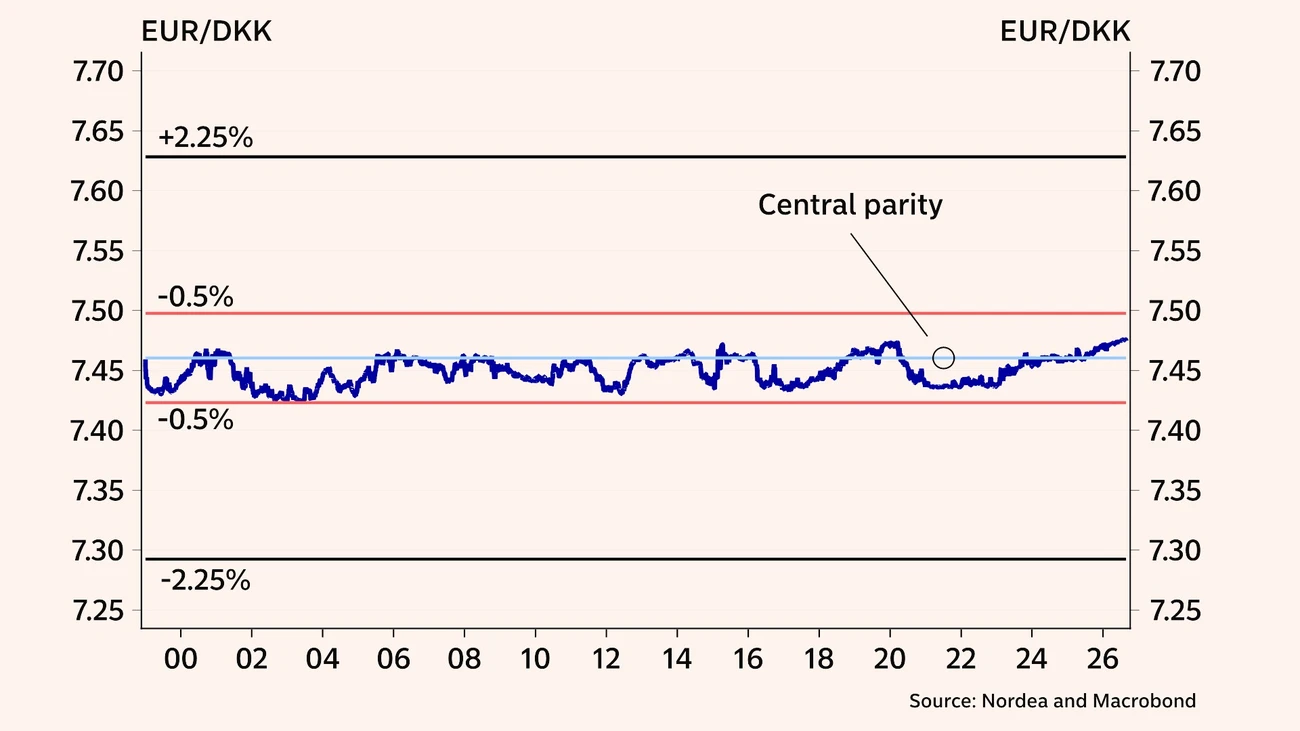
A robust Danish economy means that the Nationalbank can allow the krone to fluctuate more symmetrically around the central parity against the euro.
As shown in the figure, the krone has not traded symmetrically around the central parity. This is because the Nationalbank has traditionally been most concerned about a weakening of the krone against the euro. This stems from the consideration that the Nationalbank theoretically has access to an unlimited supply of Danish kroner through the printing press. Conversely, intervention to combat a weak krone drains the foreign exchange reserve, which is, after all, of limited size.
Since mid-2025, the krone has weakened against the euro. This has occurred because non-financial Danish companies have reduced their demand for kroner. This is due, among other things, to a sharp increase in foreign investments, which reduces the need to convert the ongoing surplus earned abroad back into kroner.
The most notable aspect of the recent krone weakening, however, is that the Nationalbank has allowed it to run further than before. As a result, EUR/DKK has traded up around 7.4750 over the summer, the highest level since the introduction of the euro. During this period, the Nationalbank has only made very limited attempts to curb the development through intervention.
The explanation for this greater tolerance of a higher EUR/DKK level is straightforward. On fundamental factors such as the current account surplus and public finances, Denmark is presently far better positioned than the euro area. At the same time, the foreign exchange reserve has been continuously built up to represent more than 20% of GDP. The risk of speculative pressure seeking to weaken the Danish krone is therefore becoming increasingly unlikely. Viewed in that light, a more symmetric band around the central parity is a natural consequence, which in our assessment will help to keep the current interest rate differential to the euro area unchanged over the coming years.
This article first appeared in the Economic Outlook: Resilience in motion, published on 2 September 2026.
Read more from the latest Economic Outlook
Stay ahead of the curve with our expert economic insights and forecasts. Get the latest analysis on global and Nordic markets delivered straight to your inbox.
Read more
Teknologinen kehitys on pystynyt kompensoimaan geopoliittisen epävarmuuden negatiiviset vaikutukset talouteen, ja maailman kasvuvauhti on säilynyt ripeänä.
Read more
Economic Outlook
Finland’s long period of weak productivity growth finally appears to be easing. Part of the turnaround reflects a better cyclical backdrop, but the drivers of longer-term productivity growth have also strengthened.
Read more
Economic Outlook
The Finnish economy has grown broadly in the first half of the year. Growth has been seen in private consumption, investment and exports alike. We expect growth to continue despite higher fuel prices and interest rates caused by the Middle East crisis. The recovery is expected to pass through to the labour and housing markets with a lag.
Read more