Key takeaways:
- Households have room and confidence to spend
- Labour market to improve with a lag
- Housing market balancing slowly
The Finnish economy has grown broadly in the first half of the year. Growth has been seen in private consumption, investment and exports alike. We expect growth to continue despite higher fuel prices and interest rates caused by the Middle East crisis. The recovery is expected to pass through to the labour and housing markets with a lag.

The Finnish economy has seen the long-awaited turn for the better this year. The economy returned to growth around the turn of the year, and uncertainty from the Middle East, inflation and higher interest rates have not stopped growth in the second quarter either.
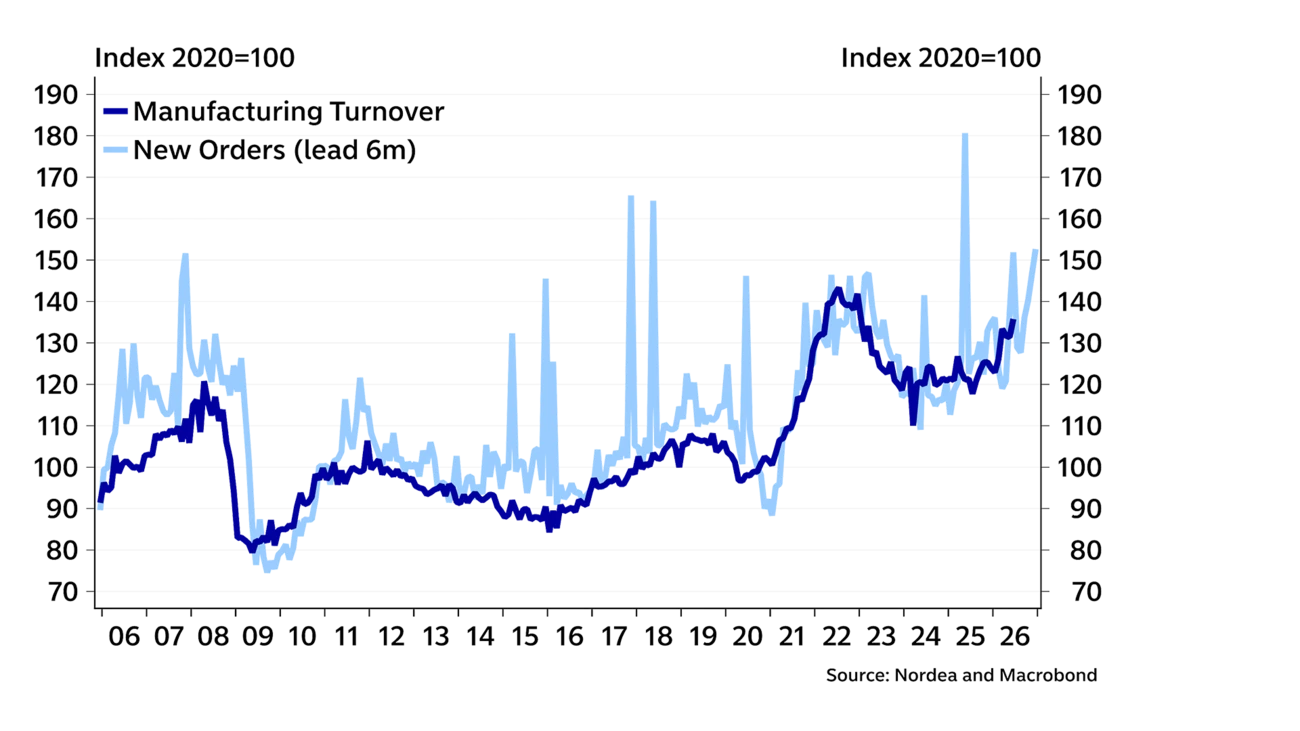
The recovery has been broad-based. Exports have performed well, especially in metals, defence and marine industries. Rising export orders indicate that industrial momentum will continue into next year. Finland has benefited from global trade growth, where geopolitical uncertainty is boosting defence investment and the AI boom is fuelling demand, not only for semiconductors but also for physical infrastructure.
In Finland, data centre projects and R&D spending have also turned investment to growth. Several infrastructure projects have lifted civil engineering as well. Residential construction remains difficult, as the housing market is still subdued despite some signs of balancing.
Households have finally loosened their purse strings, and private consumption has returned to growth after several weak years. Faster inflation and higher rates following the Middle East situation are set to slow the rapid real income growth seen recently, but households have built up solid buffers. Good economic news has therefore started to lift consumer confidence. The labour market remains weak for now, but economic growth is expected to push unemployment down.
We expect the Finnish economy to grow by 1.7% this year. In 2027 and 2028, we expect growth to speed up to 2.0%. Finland now has the conditions for a longer period of rapid growth without overheating. There is spare capacity in both labour and equipment to meet stronger demand.
A prolonged Middle East crisis and the related rise in energy prices and interest rates are a clear risk to domestic consumption.
1.7%
Our forecast for GDP growth in 2026
2.1%
Inflation in July 2026
93.0
%, Our forecast for public sector debt relative to GDP in 2028.
Inflation has accelerated to just above 2% this year as the Middle East situation has pushed up fuel prices. Finland’s national consumer price index, which includes mortgage interest, rose by 2.1% year-on-year in July, also lifted by higher interest rates. Price increases have remained moderate outside energy and interest costs. Service prices rose by 1.7% and goods prices were up by 1.1% year-on-year in July. Higher energy prices have so far not fed through to core inflation.
Inflation is expected to be 1.9% this year and next. The forecast is based on current declining oil futures prices. If the situation in Iran persists and fuel remains more expensive for longer than expected, price pressures will be stronger than forecast.
For Finland, the ECB’s rate hikes again appear poorly timed. Although the economy is growing, there are no broad inflation pressures that would require higher rates to cool them. Higher rates risk slowing Finland’s growth, although this time they are not expected to push the economy into a recession.
| ‘25 | ‘26E | ‘27E | ‘28E | |
|---|---|---|---|---|
| Real GDP, % y/y | 0.8 | 1.7 | 2.0 | 2.0 |
| Consumer prices, % y/y | 0.3 | 1.9 | 1.9 | 1.6 |
| Unemployment rate, % | 9.7 | 10.4 | 9.0 | 8.0 |
| Wages, % y/y | 3.1 | 3.1 | 2.5 | 2.4 |
| Public sector surplus, % of GDP | -3.4 | -3.3 | -2.9 | -2.5 |
| Public sector debt, % of GDP | 88.5 | 90.8 | 92.3 | 93.0 |
| ECB deposit interest rate (at year-end) | 2.00 | 2.75 | 3.00 | 2.50 |
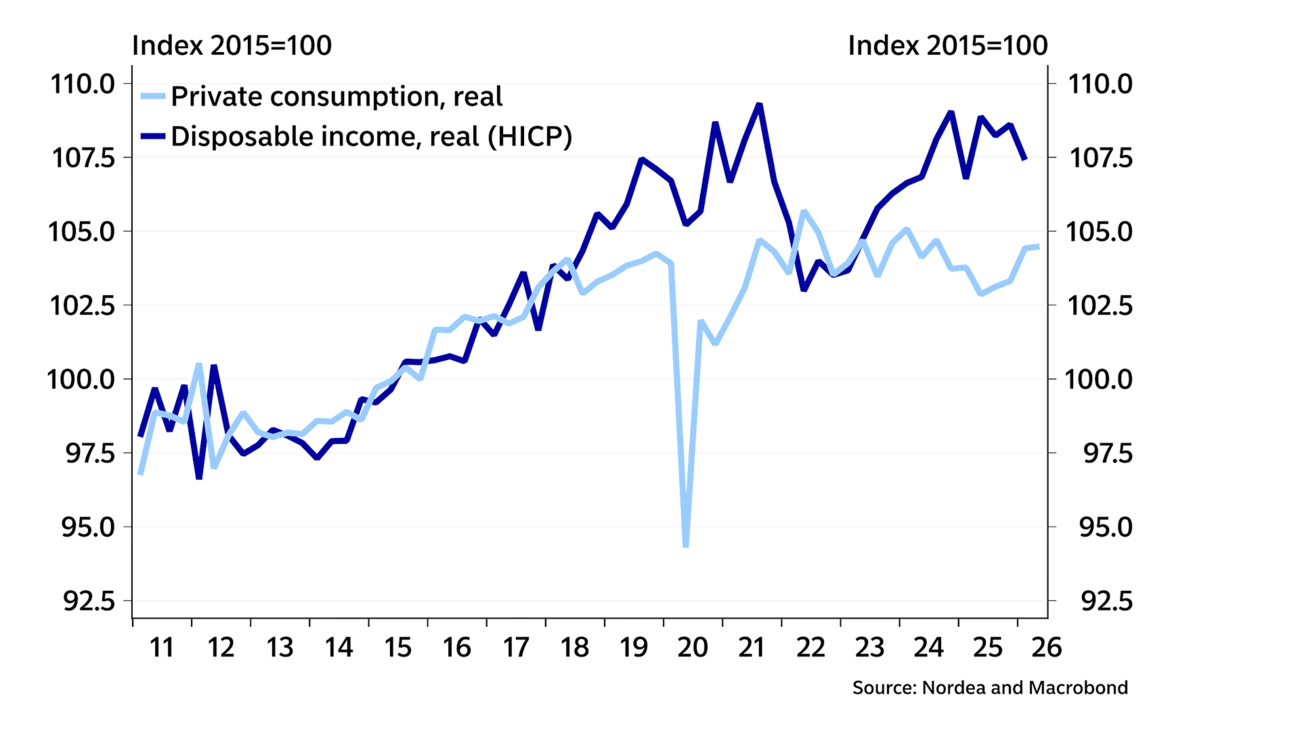
Households are finally starting to loosen their purse strings after several years of restraint.
Consumption growth is supported by stronger consumer confidence over the summer and rapid real income growth in recent years. Private consumption has continued to grow throughout the first half of the year despite uncertainty from the Iran situation and higher fuel prices.
The household savings rate remains high, and many households have repaired their balance sheets in recent years by reducing debt and building savings. Conditions for continued consumption growth are therefore good, but stronger confidence and a pick-up in the labour market are still needed.
We expect positive real earnings growth, a gradual decline in the household savings rate and improving employment to support consumption growth over the forecast period. We forecast private consumption to grow by 1.5% this year and 2.0% next year.
A prolonged Middle East situation and a stronger pass-through to energy markets and indirectly to interest rates nevertheless pose risks to the short-term outlook for consumption. Finnish consumers have been highly interest-rate sensitive in recent years, so they may again react to higher rates by reducing consumption. This time, however, the increase in rates is much smaller than in 2022, household balance sheets are in better shape and consumer confidence has remained higher.
Economic growth has not yet properly fed through to the labour market. However, the rise in the unemployment rate has started to level off, and the number of vacancies is no longer declining. Still, the unemployment rate remained high in July at 10.5%.
Typically, an economic upturn first shows up as productivity growth and only later in the labour market. Companies’ employment expectations have improved clearly this year, so a positive turn in the labour market is expected next winter.
We expect the unemployment rate to fall to an average of 9% next year and to 8% in 2028. Labour market recovery is therefore central to the recovery of domestic consumption and the housing market.
Recent labour market measures have increased the labour force participation rate despite the weak cycle. Good labour supply creates room for longer-term growth, as labour availability overall is not a constraint, even though matching problems will certainly create challenges in some sectors.
Households are finally starting to loosen their purse strings after several years of restraint.
The housing market has remained subdued, and higher interest rates earlier this year have further reduced housing transactions. Selling times have stayed long and house prices have continued to fall. Prices of old apartments declined by 3.9% year-on-year in the second quarter. Prices of small apartments in particular have continued to fall, while prices of larger family homes have already stabilised.
The rental supply remains abundant and rents are moving sideways. However, the number of vacant rental homes has started to decline gradually, indicating that oversupply is easing. Very slow construction is helping the market balance. Annual residential starts have fallen to 15,000 homes, as lower Ara authorisations have reduced subsidised rental housing construction. The number of Ara projects is expected to fall further next year. Declining supply, an improved economic environment pointing to stronger demand and higher consumer confidence are gradually laying the groundwork for a housing market recovery.
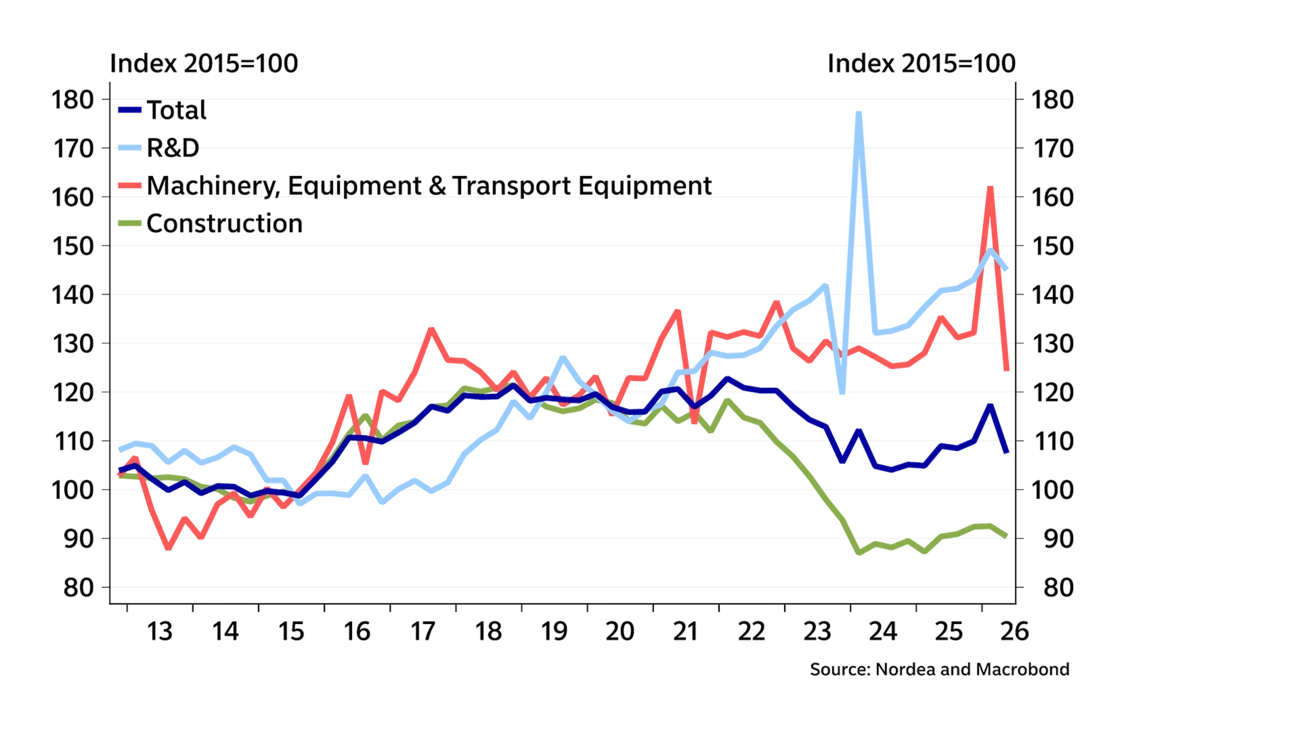
Despite challenges in residential construction, construction investment overall has turned to growth. Civil engineering has grown, driven by various rail projects. Rapidly expanding data centre projects and renovation construction are also supporting the construction sector.
Machinery and equipment investment jumped in the first quarter of the year as Finland received the first batch of F-35 fighters. The fighters will continue to move investment figures in coming years, although their impact on GDP is very small because they are mostly imported goods.
Investment surveys show that companies are now allocating more investment to product development and the use of AI, as construction has declined. R&D investment has been growing for several years, creating conditions for sustainable productivity growth. The theme article on page 18 looks more closely at productivity trends.
Investment is now supported by improved demand, foreign companies’ investments in Finland, especially in data centres and mining projects, and favourable financial market conditions. Finland’s competitiveness for many investments is good.
Finnish goods exports and industrial production have turned to strong growth this year, driven by global economic growth.
Exports have been driven by rising demand for defence equipment in Europe and growing investment related to AI, as well as electricity generation and transmission in the United States. The US’s cautious stance towards machinery and equipment made in China also supports demand for some Finnish products. Cruise ships and icebreakers, meanwhile, are keeping the marine industry busy.
The value of industrial orders increased by an average of 7.3% in the first half of the year, pointing to continued industrial growth in the second half. Order trends were especially positive in the metal industry, while the forest industry cycle remains subdued.
Public sector deficits have remained above 3% of GDP despite the government’s consolidation measures. The weak economic cycle and high public sector wage increases have eroded part of the impact of the adjustment measures.
Nascent economic growth has nevertheless started to show gradually in tax revenues this year. The improving cycle is expected to reduce public sector deficits. On the other hand, large government investments in defence will show as a one-off rise in public investment spending this year and in the coming years, keeping deficits large even as the underlying budget balance improves. Rising interest expenditure also adds spending pressure as the increase in long-term rates appears to continue.
We expect the public sector deficit to narrow below 3% in the coming years. The public debt ratio is expected to keep rising. The debt ratio will exceed 90% this year, and the increase is expected to continue in the coming years despite a narrowing deficit and solid economic growth.
Get the economic outlook for Finland directly from our economists in this on-demand webinar (in Finnish).
See the webinar
Stay ahead of the curve with our expert economic insights and forecasts. Get the latest analysis on global and Nordic markets delivered straight to your inbox.
Read more
Teknologinen kehitys on pystynyt kompensoimaan geopoliittisen epävarmuuden negatiiviset vaikutukset talouteen, ja maailman kasvuvauhti on säilynyt ripeänä.
Read more
Economic Outlook
Finland’s long period of weak productivity growth finally appears to be easing. Part of the turnaround reflects a better cyclical backdrop, but the drivers of longer-term productivity growth have also strengthened.
Read more
Economic Outlook
Despite higher energy prices and geopolitical uncertainty, the Danish economy continues to grow at a solid pace. The pharmaceutical industry remains the key driver of growth, but momentum is now also broadening to other parts of the economy.
Read more