Key takeaways:
- Economic growth continues at a high pace.
- Low Danish inflation compared to other countries.
- Public finances under pressure.
- House prices continue to increase.
Despite higher energy prices and geopolitical uncertainty, the Danish economy continues to grow at a solid pace. The pharmaceutical industry remains the key driver of growth, but momentum is now also broadening to other parts of the economy. We expect this more broad-based recovery to continue throughout the forecast period. The flip side is that public finances are coming under pressure, while the current account surplus is gradually narrowing.

The Danish economy entered the second half of 2026 from a position of considerable strength. In the first six months of the year, activity was more than 5% higher than in the same period last year. Even allowing for somewhat more subdued performance in the remainder of the year, this points to overall growth of just under 4% in 2026. This marks a significant upward revision from our previous spring forecast of 2.1%.
Over the coming years, we expect the Danish recovery to continue, although at a somewhat more moderate pace. For 2027, we forecast growth of 2.3%, which is also an upward revision from our previous estimate of 1.9%. We are also including 2028 in our forecasts for the first time, and expect Danish GDP growth to be just below 2% that year.
The unresolved situation in the Middle East and the risk of another sharp increase in energy prices add downside risk to our growth profile for the Danish economy. Conversely, a resolution of the conflict could further fuel optimism and once again result in us underestimating the Danish economy's growth potential.
Anticipated GDP growth in 2026
Expected inflation in 2026
Percentage points, spread between deposit rates – Danish central bank and ECB
Tax cuts and duty reductions have given household purchasing power a solid lift since the start of the year. This has translated into stronger retail sales and higher car sales. However, the recovery in consumption has been held back by persistently high savings, with households setting aside almost 10% of their disposable income on average.
The subdued willingness to spend is also reflected in consumer confidence surveys, which remain well below their historical averages. Sentiment is being weighed down in particular by households' assessment of the Danish economy. In recent months, however, there has been a significant improvement in households' expectations for their own financial situation one year ahead. If that optimism materialises, it could lead to a faster recovery in consumption. Against this backdrop, we expect private consumption to grow by around 2% annually in both 2026 and 2027.
The recovery in public consumption is likely to be even stronger. This is mainly due to the significant increase in defence spending, which is set to rise to 3.5% of GDP. However, there is still considerable uncertainty about how and when the additional defence funding will translate into actual consumption and investment.
| ‘25 | ‘26E | ‘27E | ‘28E | |
|---|---|---|---|---|
| Real GDP, % y/y | 3.5 | 3.8 | 2.3 | 1.9 |
| Consumer prices, % y/y | 1.9 | 1.6 | 2.1 | 2.2 |
| Unemployment rate, % | 2.9 | 3.0 | 3.1 | 3.2 |
| Current account balance, % of GDP | 12.2 | 11.2 | 10.5 | 9.8 |
| General gov. budget balance, % of GDP | 2.9 | 0.9 | -0.3 | -0.4 |
| General gov. gross debt, % of GDP | 26.8 | 26.2 | 25.4 | 25.0 |
| Monetary policy rate (end of period) | 1.60 | 2.35 | 2.60 | 2.10 |
| USD/DKK (end of period) | 6.37 | 6.44 | 6.22 | 6.07 |
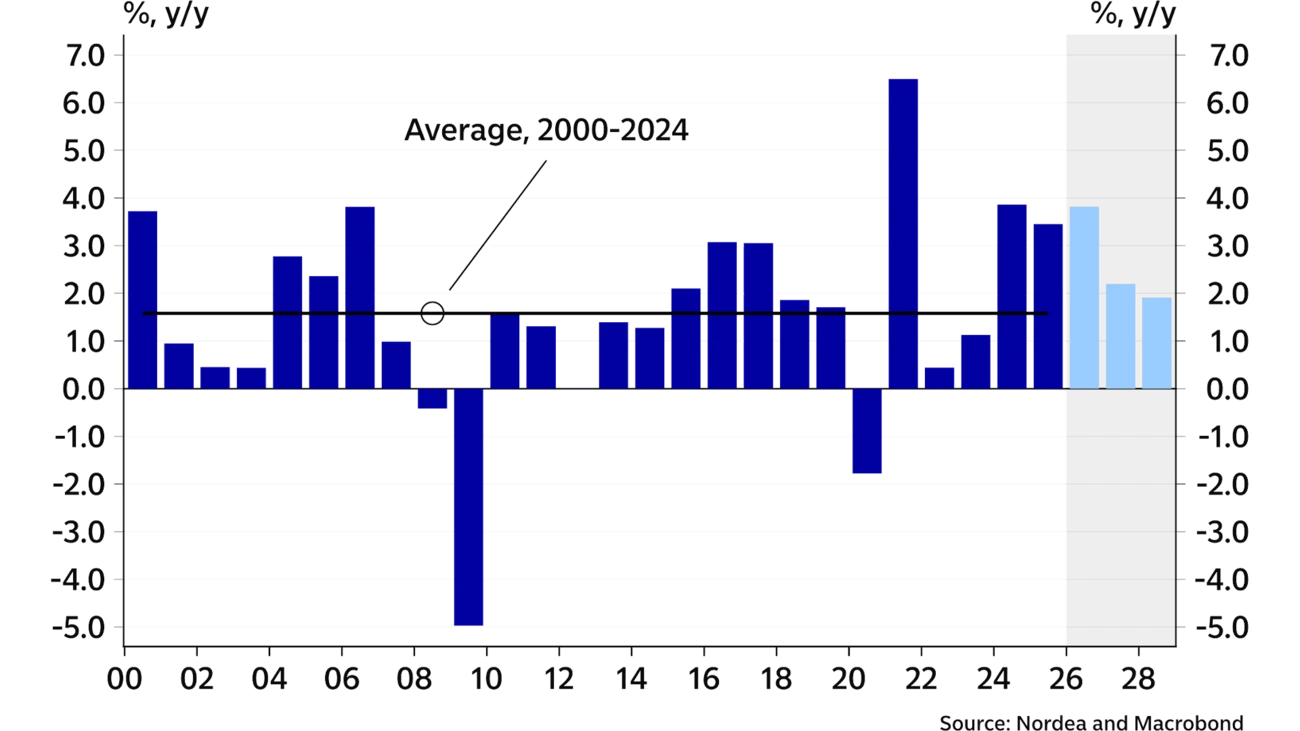
Rock-solid growth in the Danish economy.
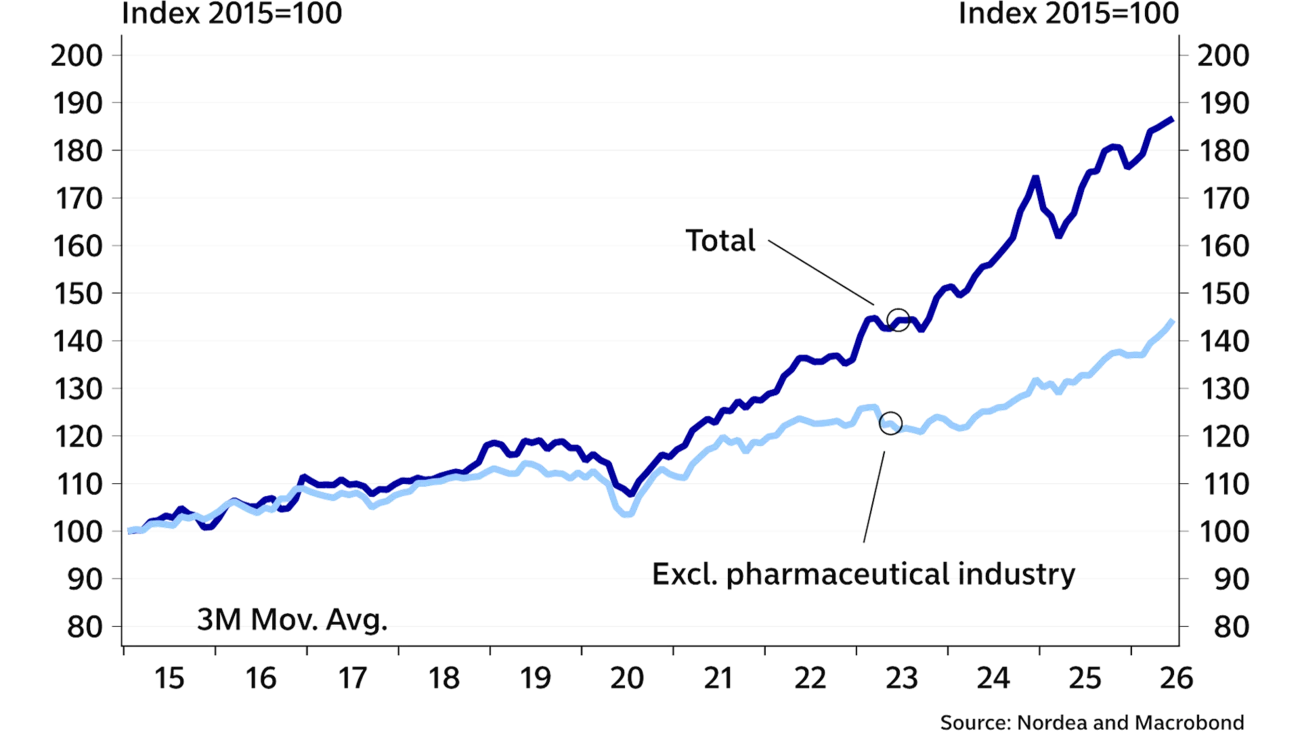
Overall, Danish industrial production has grown significantly faster than in other countries over the past five years. Production in Denmark is now more than 60% higher than at the start of 2021, while production in Germany has fallen by around 10% over the same period. The strong growth in Danish industrial production has primarily been driven by the rapidly expanding pharmaceutical industry. In this context, however, it is important to emphasise that the figures cover production by Danish industrial companies both in Denmark and abroad.
Since the start of the year, however, there has been a notable shift. Activity outside the pharmaceutical industry is now growing the fastest. This has been driven in part by the important machinery industry, which accounts for more than 15% of total production. Production in this segment has risen steadily throughout the first half of the year, with engines, wind turbines and pumps making a particularly large contribution to growth.
The higher level of activity is also reflected in the industrial business confidence indicator, where companies expect production to increase heading into autumn. Once again, the machinery industry stands out positively, with a sharp decline in the share of companies citing lack of demand as a constraint on production. This provides a solid basis for continued growth in industrial production over autumn.
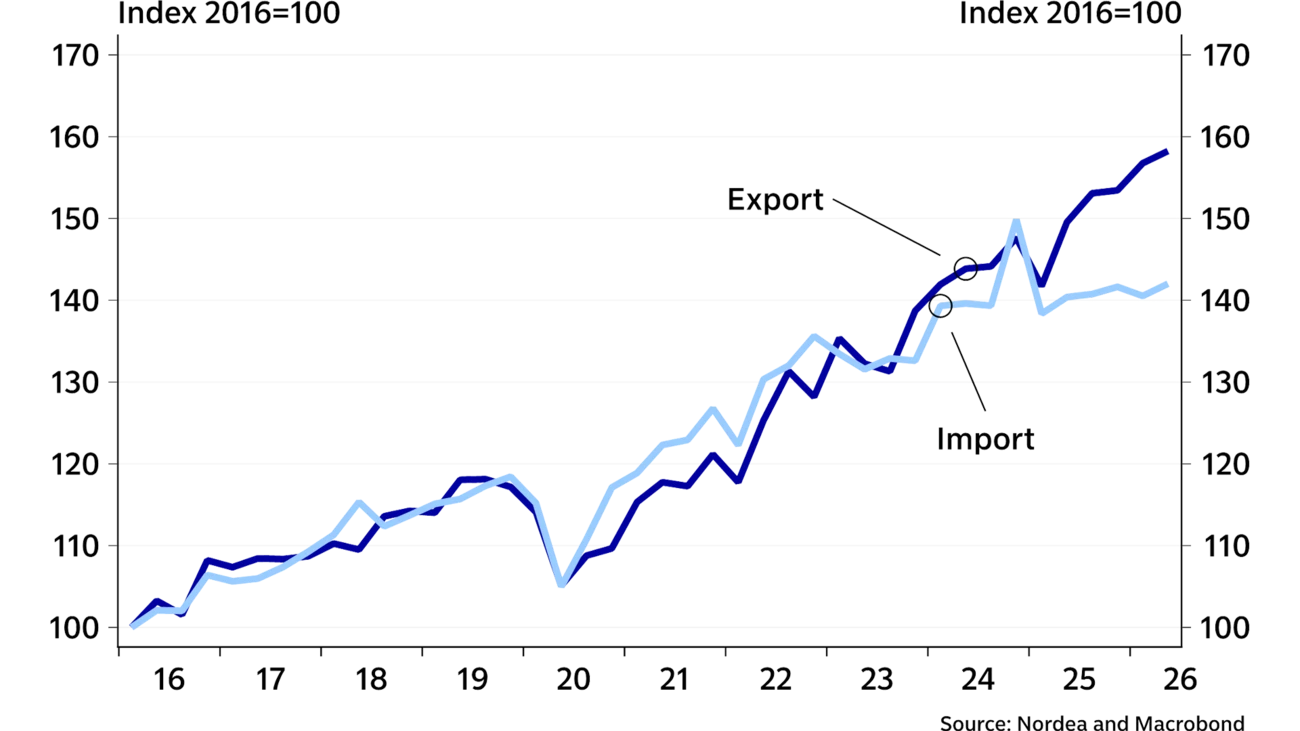
Over the past three years, strong growth in net exports has been the main contributor to overall growth in the Danish economy. The marked improvement in the pharmaceutical industry has been a decisive factor. This trend continued in the first half of 2026, with exports of goods and services rising by just over 8% in total, while imports increased by less than 2% over the same period. This growth has also helped keep the current account surplus at a historically high level of more than 12% of GDP.
We expect exports to continue growing solidly in the coming years. However, the current account surplus is likely to narrow as consumption rises in both the public and private sectors.
Over the summer, Danish consumer prices rose by just under 2% year-on-year. This happened even though petrol and diesel prices were around 20% higher than in the same period last year. By contrast, the Danish Parliament's decision to temporarily reduce the electricity tax to the EU minimum from the start of the year has helped keep inflation down. Lower electricity prices alone are estimated to have reduced inflation by more than 0.5 percentage points in 2026. As a result, households have been partly shielded from rising energy prices during the year, leaving Denmark with one of the lowest inflation rates in Europe.
We estimate average inflation at 1.6% this year, compared with just under 1.9% in 2025. If no new tax reductions are introduced, we expect inflation to rise above 2% again in 2027. However, political negotiations are under way that could potentially result in an agreement to reduce VAT on all or selected food items. If so, the period of relatively low inflation could be extended.
It is primarily the prospect of further employment growth and continued strong revenues from the pension yield tax that will presumably sustain the surplus in Denmark’s public finances. Together with the large balance on the government’s account with the Danish central bank, this looks set to ensure that public gross debt remains steadily below 30% of GDP in the coming years.
Denmark has recorded a public finance surplus in each of the past 10 years. Since 2019, the surplus has also been the largest in the EU relative to GDP. The strong public finances have helped push gross public debt steadily lower, and it now stands below 27% of GDP.
Rapidly rising expenditure on rebuilding Denmark's defence capabilities is, however, putting increasing pressure on public finances. Public finances still showed a surplus of just over DKK 9 billion in the first three months of the year, but this was nevertheless the smallest first-quarter surplus since 2018. This points to a new phase for public finances, in which expenditure may exceed revenue for a period. Specifically, we expect a small public balance deficit in both 2027 and 2028, which would be the first time since 2015. However, revenues from the pension savings tax could once again turn out higher than expected.
One of the main reasons for the long period of exceptionally strong public finances is the labour market, where employment continues to reach new highs. Over the past six years alone, the number of employees in the Danish labour market has increased by around 10%. This strong growth has been supported by a steadily rising inflow of foreign labour and a series of reforms that have significantly lifted employment rates, particularly among people over the age of 60.
Last year, the number of redundancy notices rose sharply, partly reflecting developments in the pharmaceutical industry. At the same time, unemployment has edged slightly higher and now stands at 3.1%. Even so, the number of job vacancies has increased moderately since mid-2025. This suggests that it has become somewhat more difficult to match the qualifications of unemployed workers with the needs of businesses.
Taken together, these developments suggest that the rapid employment growth seen in recent years is beginning to slow. However, this is unlikely to be enough to trigger any marked shift in unemployment, which is still projected to remain stable at around 3.0% in the coming years.
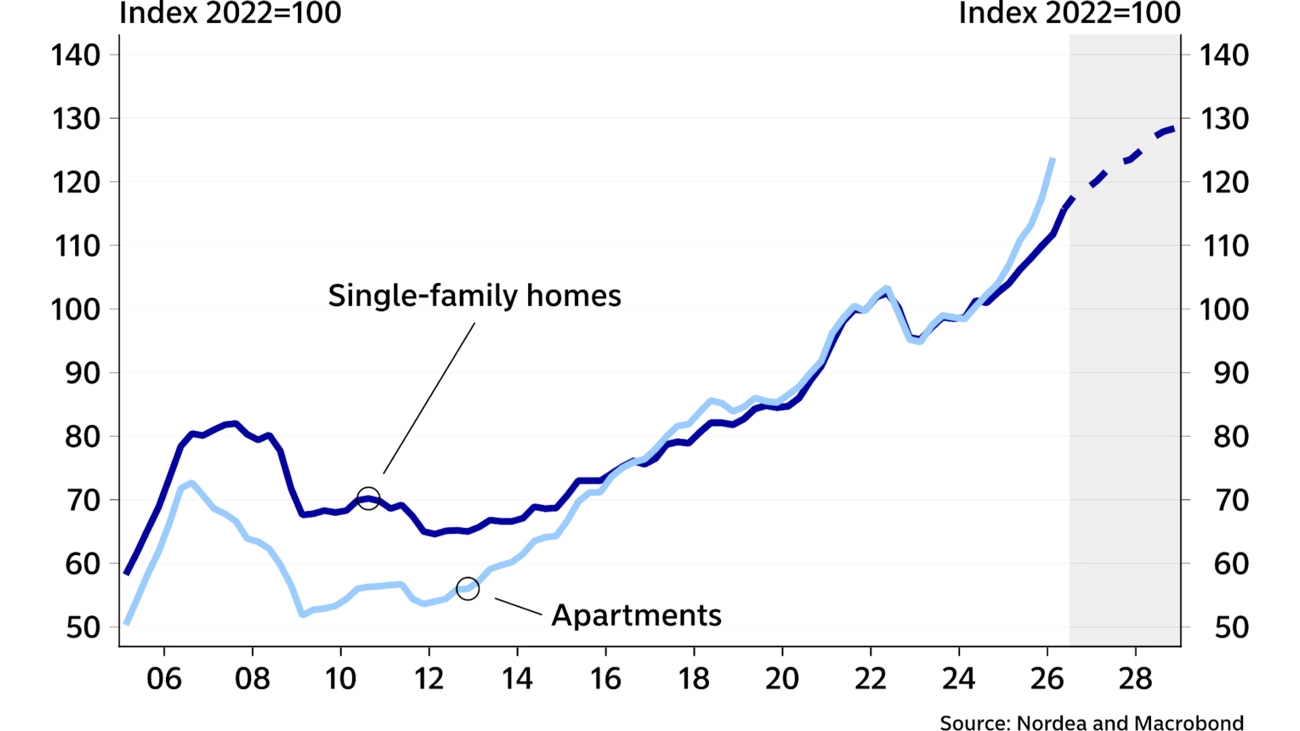
Activity in the Danish housing market has been high since the start of the year. The market has been driven in particular by rising employment, which, combined with a low supply of homes for sale, has pushed prices higher. At the same time, the supply of newly built houses has been low for several years, adding upward pressure on prices for existing homes.
Price increases have been broad-based across both regions and property types. The strongest growth has been in the Greater Copenhagen area, where owner-occupied apartments in particular have risen sharply in price. However, the latest data suggests that the rally there is quickly losing momentum. A large increase in the supply of apartments for sale slowed price growth over the summer, and a pullback in prices for owner-occupied apartments in Greater Copenhagen cannot be ruled out heading into autumn. Outside Copenhagen, however, there are no signs of a slowdown in prices for owner-occupied apartments in other major Danish cities – quite the opposite.
In our forecast, we expect house prices to rise by an average of 8.4% in 2026, followed by growth of 5.3% in 2027 and 4.0% in 2028. Overall, the pace of house price increases is likely to gradually slow over the forecast period. This partly reflects the already high price levels around the largest cities. At the same time, higher interest rates may also have a dampening effect on the housing market. We also expect further price increases in the owner-occupied apartment market. However, in contrast to previous years, price increases for owner-occupied apartments are expected to be smaller than for houses.
This article first appeared in the Economic Outlook: Resilience in motion, published on 2 September 2026.
Read more from the latest Economic Outlook
Stay ahead of the curve with our expert economic insights and forecasts. Get the latest analysis on global and Nordic markets delivered straight to your inbox.
Read more
Teknologinen kehitys on pystynyt kompensoimaan geopoliittisen epävarmuuden negatiiviset vaikutukset talouteen, ja maailman kasvuvauhti on säilynyt ripeänä.
Read more
Economic Outlook
Finland’s long period of weak productivity growth finally appears to be easing. Part of the turnaround reflects a better cyclical backdrop, but the drivers of longer-term productivity growth have also strengthened.
Read more
Economic Outlook
US technology stocks have delivered very strong returns in recent years, both in absolute terms and relative to other markets. This has contributed to a strong dollar. However, the path to profitability for AI-related companies remains unclear. A sharp decline in the US equity market could lead to a significantly weaker dollar.
Read more