This article first appeared in the Nordea Economic Outlook: Resilience in motion published on 2 September 2026.
Read more from the latest Economic OutlookEconomic Outlook
AI downturn would weaken the dollar
US technology stocks have delivered very strong returns in recent years, both in absolute terms and relative to other markets. This has contributed to a strong dollar. However, the path to profitability for AI-related companies remains unclear. A sharp decline in the US equity market could lead to a significantly weaker dollar.

The US equity market, led by AI-related companies, has clearly outperformed in recent years. Strong returns have attracted substantial amounts of foreign capital while also supporting the dollar. Both the US equity market and the dollar are therefore vulnerable to the profitability outlook for AI-related companies.
A large share of AI industry revenues is driven by model developers such as OpenAI and Anthropic and their need for ever-increasing data centre capacity. However, the model developers are still running large losses. For now, they can sustain demand through continued access to new capital, but this cannot last forever. If profitability fails to materialise and access to capital declines, demand further down the value chain will fall – and with it, earnings and valuations.
The euphoria surrounding the technology and expectations of an enormous future market have attracted substantial investment into model development, sharply intensifying competition. Since the launch of ChatGPT, the number of model developers has grown exponentially. Among the leading models, the top position keeps changing, while quality differences are often small and switching costs low. Model developers are also facing growing competition from open, free models, particularly from Chinese developers that have sharply increased their investment. Fierce competition turns models into rapidly depreciating infrastructure and forces developers to invest continuously to stay competitive.
AI companies also face pricing pressure because users are sensitive to higher costs. Unlike traditional software, AI has much higher marginal costs because every response requires compute. Users have long been shielded from this through subsidised pricing. As prices rise, costs become visible: in KPMG’s latest survey, half of respondents had cut or stopped AI use due to cost.
With fierce competition, rapidly ageing models, growing pressure from China and cost-sensitive demand, the path to profitability remains unclear. As the rest of the value chain depends on model developers succeeding, this leaves the US equity market vulnerable. Any sharp decline in AI stocks would be particularly concentrated in the US.
With intense competition and cost-sensitive demand, the path to profitability for AI companies remains unclear.
This draws clear parallels with the dot-com bubble around the turn of the millennium. The dollar remained strong during the initial phase of the downturn, but weakened significantly in the years that followed. During the second half of the 1990s, the US had attracted large amounts of foreign capital. As optimism around technology faded, so did US dominance in the global growth picture. In the years that followed, the relative value of the US equity market globally declined in tandem with the value of the USD.
The dollar weakened after the dot-com bubble
EURNOK and USDNOK
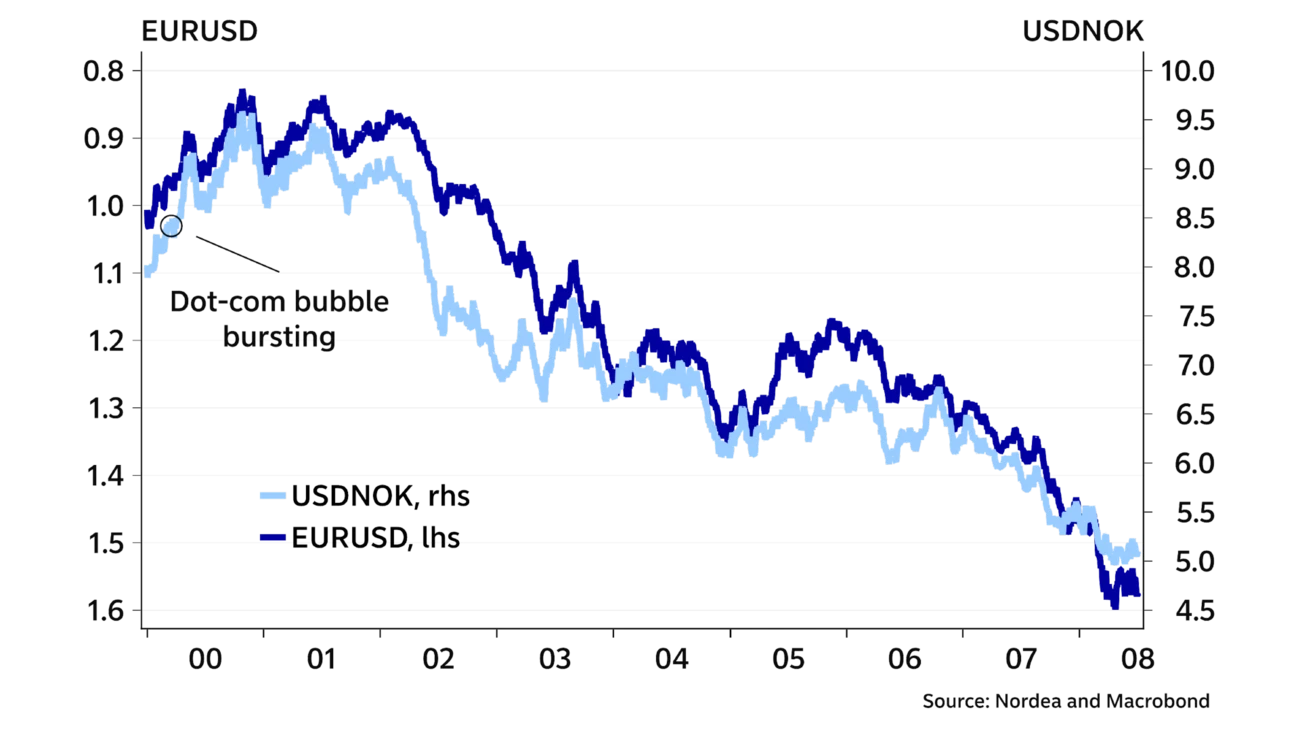
At the time, the US had – and still has – a significant current account deficit. As long as the global appetite for US assets remains strong, this deficit is relatively easy to finance. If the willingness to hold US assets were to decline, asset values could be hit hard. If such a correction occurred now, it would not be surprising to see a broadly similar outcome, with a corresponding sharp fall in USDNOK.
Authors

- Name:
- Kirsti Sunde Midttun
- Title:
- Analyst, Nordea

- Name:
- Sara Midtgaard
- Title:
- Senior Strategist, Nordea

Nordean pääekonomisti: Uutta kohti
Teknologinen kehitys on pystynyt kompensoimaan geopoliittisen epävarmuuden negatiiviset vaikutukset talouteen, ja maailman kasvuvauhti on säilynyt ripeänä.
Read more
Economic Outlook
Productivity turns a corner in Finland
Finland’s long period of weak productivity growth finally appears to be easing. Part of the turnaround reflects a better cyclical backdrop, but the drivers of longer-term productivity growth have also strengthened.
Read more
Economic Outlook
Norway Economic Outlook: Not there yet
Underlying inflation is likely to pick up again after its summer decline and remain around 3% through year-end. Inflation is therefore still where it was two years ago, while unemployment remains low.
Read more