This article first appeared in the Nordea Economic Outlook: Resilience in motion, published on 2 September 2026.
Read the full reportEconomic Outlook
Productivity turns a corner in Finland
Finland’s long period of weak productivity growth finally appears to be easing. Part of the turnaround reflects a better cyclical backdrop, but the drivers of longer-term productivity growth have also strengthened.

A long productivity slump weighed on the economy
One of Finland’s biggest economic challenges for almost two decades has been weak productivity growth. A deep structural shift has been a key factor: output in high-productivity telecommunications and forest industries has fallen sharply, while manufacturing’s share of total value added has declined by around 10 percentage points since the 2000s. At the same time, too few new high-productivity jobs have emerged to replace them.
Structural change alone does not explain the weakness. Productivity growth has also been broadly subdued within sectors. The comparison with Sweden is revealing: Sweden has managed to raise productivity in services much more clearly than Finland, and exports of digital services have replaced goods exports more effectively. One reason has been Swedish companies’ sizeable investments in IT equipment, software and databases.
A broader turnaround was also delayed by the sharp fall in R&D investment after Nokia’s peak years, which weakened the economy’s ability to generate new high-value-added production.
Productivity figures are also affected by the business cycle. In recessions, companies often leave capacity underused, weighing on output per hour worked. When growth resumes, the pattern usually reverses quickly: output can rise without a corresponding increase in labour input. A weaker cycle has also forced companies to streamline operations and cut excess costs.
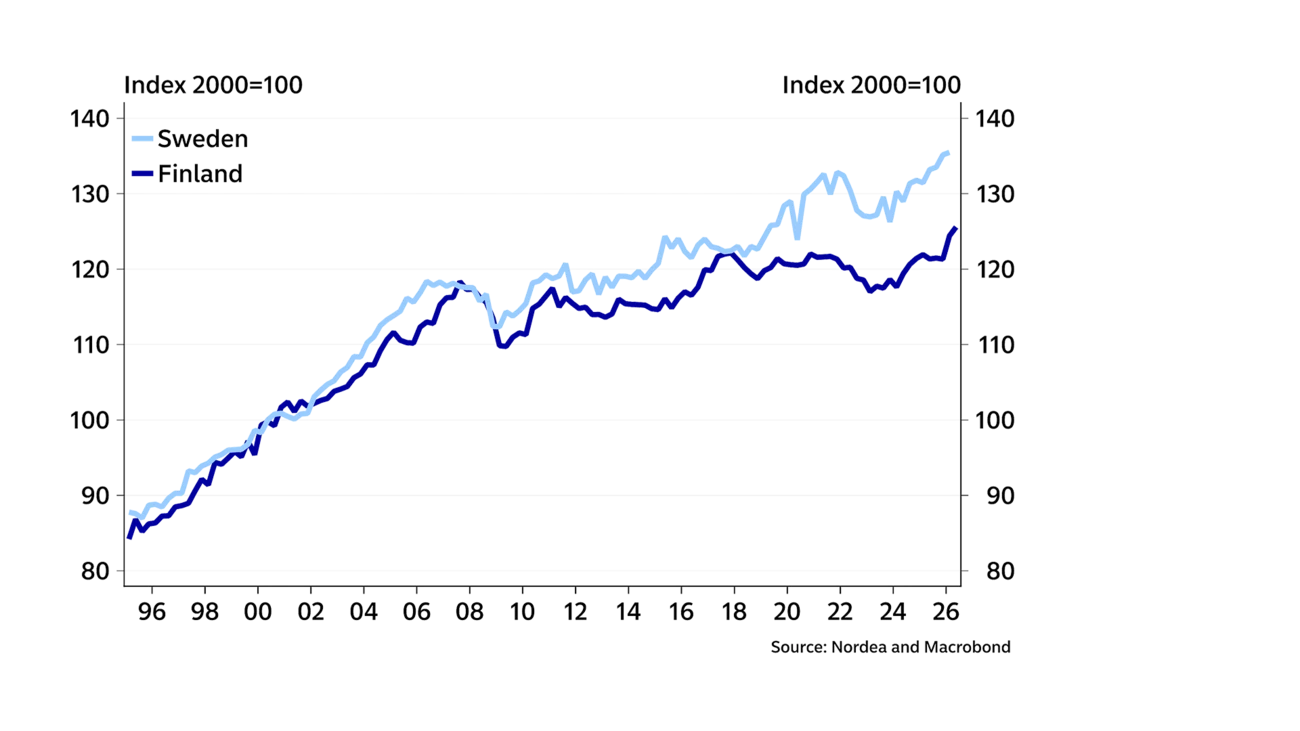
Recent figures suggest that Finland's productivity has finally returned to growth.
Growth is now generated more efficiently
Recent figures suggest that Finland’s productivity has finally returned to growth. Productivity per hour worked increased by 2.8% year-on-year in the second quarter.
The turnaround is partly supported by a better cyclical environment, but it does not appear to be merely a cyclical rebound. The conditions for more lasting productivity growth have also improved. For example, research and development investment has been rising since 2018, while other productive investments have held up despite the weak cycle.
The number of new growth companies in Finland has risen strongly, and access to venture funding has improved. This could support further productivity gains. The US experience demonstrates that many highly productive new companies emerge from the startup ecosystem with the help of venture capital.
Improved productivity also helps explain why the recovery has not yet translated into higher employment. In the IT sector, for example, employment has declined in recent years even as the sector’s value added has grown strongly.
Artificial intelligence (AI) has already raised efficiency in the IT sector, and its productivity benefits are likely to spread gradually to other industries as companies gain the confidence to invest in AI adoption. Finland has the potential to be among the major beneficiaries of AI.
Finland’s attractiveness for industrial investment has improved in recent years due to moderate wage increases and affordable electricity. High-productivity industrial jobs requiring large investments may still emerge in Finland, even though manufacturing’s share of the economy has declined over recent decades.
Finland also has some catch-up potential, as productivity growth lagged peer countries for a long time. Closing the gap will not happen automatically. It requires bold adoption of new technologies and innovations, as well as investments that permanently raise labour productivity.
Productivity has returned to growth
Author
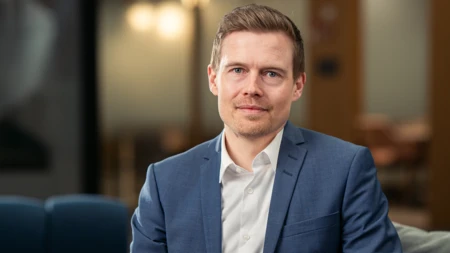
- Name:
- Juho Kostiainen
- Title:
- Economist, Nordea

Economic Outlook
Economic outlook: Global Resilience
Global growth has continued to be robust and is benefitting from rapid technological development, which is boosting fixed asset investment.
Read more
Markets and investment
FX risk management: How Sweden’s large corporates are responding
With currency risk showing no signs of easing, Sweden’s largest corporates are taking markedly different paths to managing FX risk, from full hedging to no hedging at all. Four treasury leaders share how they think about the challenge.
Read more
Sustainability
Turning climate ambition into action
As companies move towards a lower-carbon economy, many are asking what a climate transition plan looks like in practice. At Nordea, we support customers through dialogue, advice and financing solutions tailored to their needs.
Read more