- Name:
- Richard Hayes
- Title:
- Chief Strategist, Transaction Banking
Denne siden findes ikke på norsk
Bli værende på denne siden | Fortsett til en lignende side på norskThe landmark EU-Mercosur deal eliminates 91% of tariff lines for EU exports, creating major opportunities for Nordic companies while requiring careful risk management.
After 25 years of negotiations, the European Union and Mercosur trade agreement has finally been signed, creating one of the world’s largest free trade zones covering 700 million consumers. For Nordic countries, this landmark deal presents unprecedented opportunities and important considerations for supply chain strategy.
As highlighted in our recent Trade Trends webinar, this agreement exemplifies the EU’s pursuit of autonomy in an era of great power rivalry. With the EU being the world’s third-largest economy but not a dominant global power, free trade agreements represent crucial tools for maintaining competitiveness and market access.
Consider the numbers: In 2024, EU-Mercosur trade reached EUR 112bn, with EU imports from the region growing by over 50% in the past decade. Of EU imports from Mercosur, 80% consist of primary goods, while 90% of EU exports to the region are manufactured products.
For Nordic countries, this landmark deal presents unprecedented opportunities and important considerations for supply chain strategy.
The agreement will eliminate tariffs on 91% of EU export lines to Mercosur, creating substantial opportunities across key Nordic areas:
Machinery and industrial equipment: Current tariffs of 14-20% will be phased out over 10-15 years, significantly improving competitiveness for Nordic manufacturers.
Healthcare and pharmaceuticals: With Brazil spending 10% of GDP on healthcare (over USD 135bn) and medical imports increasing 60% since 2022, Nordic companies are well-positioned to capitalise on growing demand and streamlined regulatory processes.
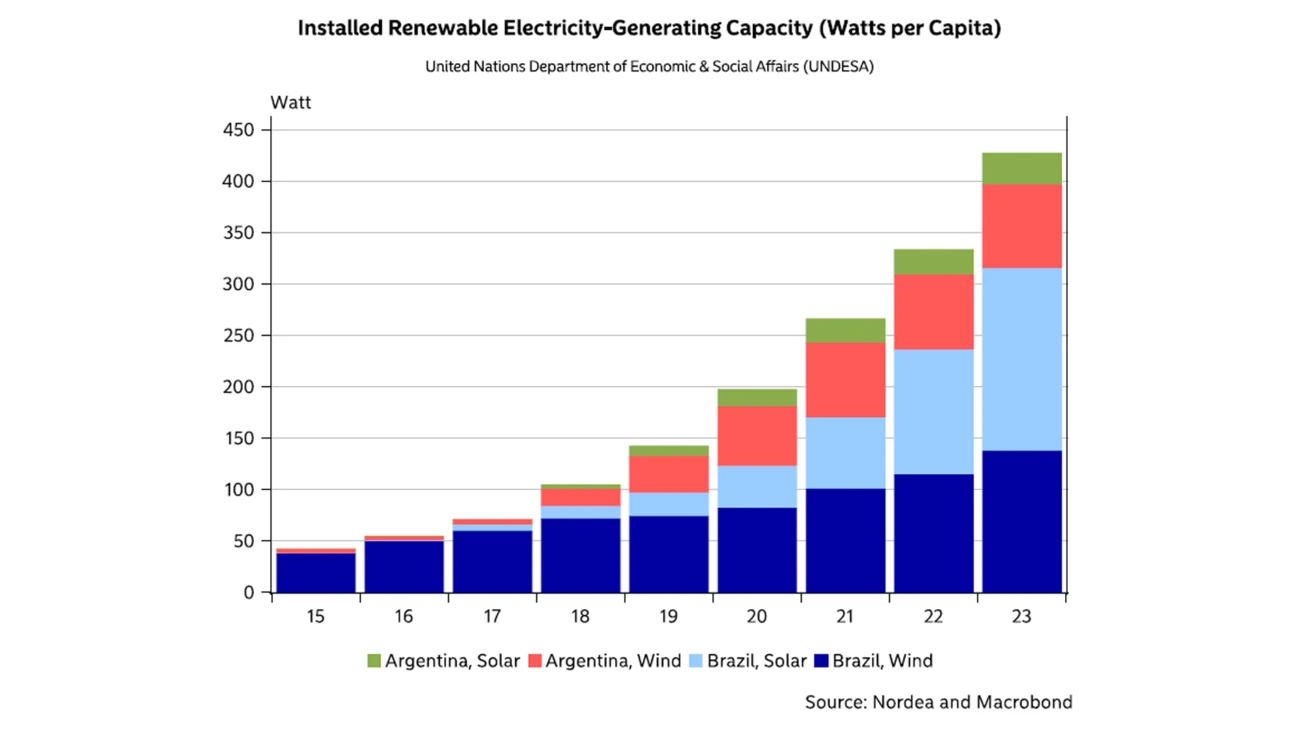
Clean energy technology: The agreement opens access to government procurement contracts in a region experiencing explosive clean energy growth. Solar and wind generation in Brazil and Argentina has increased by 960% (in watts per capita) since 2015, aligning with Nordic expertise.
Digital and professional services: Nordic strengths in consulting, IT, architecture and logistics will benefit from liberalised service markets across finance, telecoms and maritime transport.
For Nordic importers, the agreement offers compelling opportunities for supply chain resilience. Brazil, as a major iron ore exporter, could provide cost-effective alternatives for Nordic manufacturers. Interestingly, despite being the world's second-largest iron ore exporter, Brazil doesn't currently rank among Sweden's top five suppliers, indicating significant untapped potential.
Agricultural sectors also stand to benefit, with Danish pork producers and Norwegian seafood exporters gaining access to cheaper feed inputs like soy meal, potentially reducing costs by 1-3%.
The agreement isn't without challenges. Agricultural competition remains a concern, with beef, poultry, sugar, and ethanol imports potentially creating margin pressure for Nordic producers. However, protective measures including tariff rate quotas limit exposure – for instance, the beef quota represents only 1.6% of EU consumption.
Supply chain considerations include potential new dependencies on Mercosur commodities and the need for robust ESG compliance, particularly regarding deforestation-linked products. Political volatility in Argentina and Brazil also requires careful risk management.
Nordic companies should consider three key scenarios: cost-driven diversification leveraging lower import costs, green compliance focusing on ESG-compliant sourcing, and strategic export expansion requiring local partnerships and market presence.
Success will depend on addressing critical questions: positioning for first-mover advantage, managing logistical bottlenecks, ensuring supplier traceability and developing appropriate hedging or insurance strategies for political and currency risks.
While the European Court of Justice reviews the agreement (potentially taking up to 24 months), a temporary implementation is likely. Nordic businesses should begin strategic planning now to capitalise on this historic opportunity that promises to reshape trade relationships and supply chains for decades to come.
In case you missed it, watch the full Trade Trends webinar here.

Economy
NATO’s new defense spending target will more than double European military budgets by 2035, with significant economic implications, clients heard at a recent Nordea event on Arctic security policy.
Read more
Private economy
Did you know how unequal many financial areas still are for women? Here's a list of facts that might surprise you.
Read more
Markets and investment
Leading up to MIPIM 2026, Nordea’s Simon Stein reflects on investor sentiment, market trends and where real estate opportunities are emerging.
Read more