This article first appeared in the Nordea Economic Outlook: Northern Lights, published on 21 January 2026.
Read more from the latest reportEconomic Outlook
New measure of unemployment in Sweden
The Swedish employment rate is among the highest in Europe, yet unemployment is close to 9%, according to the Labour Force Survey. There are strong reasons to take a more nuanced view of unemployment and shift the focus to register-based measures.

Sweden’s high employment rate remains a strength. However, according to Statistics Sweden’s Labour Force Survey (LFS), the high unemployment reflects substantial unused resources in the economy. A large share of the population is active in the labour market, which is a prerequisite for a high employment rate. However, this means that there is a group that either cannot find work or requires more time to do so.
Unemployment is a key factor in shaping both fiscal and monetary policy, so it is crucial that it accurately reflects reality. An overly rosy picture could underestimate the need for action, while an overly bleak one could overstate it and sideline measures in other areas. Therefore, there are strong reasons to take a more nuanced view of unemployment.
Mixed labour market picture
In Sweden, the LFS – a household questionnaire – has long been the established measure of unemployment. In recent years, however, the LFS has increasingly diverged from other indicators. In the neighbouring countries of Denmark and Norway, unemployment is measured mainly using register-based data. Sweden also has register-based alternatives, such as Statistics Sweden’s Population by Labour market status (BAS) survey – a relatively new statistical dataset that classifies the population by labour market status using the same principles as the LFS. Employment and unemployment are based on data from the Swedish Tax Agency and the Swedish Public Employment Service. BAS is a full survey and thus avoids the uncertainty, non-response issues and volatile data associated with the LFS. According to BAS, unemployment stood at 5.6% in October, well below the LFS figure of 9.4% for the same month and significantly lower than the Swedish Public Employment Service’s measure, even though both are based on the same register. The reason is that many of those registered with the Public Employment Service also received employment income and are thus classified as employed in BAS.
The view of unemployment in Sweden needs to be nuanced.
The key difference between BAS and the LFS is that BAS counts only individuals registered with the Public Employment Service as unemployed, while the LFS includes anyone not employed but able and actively seeking work. The LFS’ definition of “seeking work” is generous – simply reading a job ad, asking contacts or attending a fair is enough. Thus, one-third of the unemployed are full-time students, half of them high school students aged 15-19. This group mainly seeks extra jobs and does not pose a labour market challenge. The potential labour supply from these individuals is likely limited in terms of hours. This explains why some people classified as jobseekers in the LFS choose not to register with the Public Employment Service and are thus not counted as unemployed in BAS. Excluding full-time students, BAS and LFS unemployment figures are almost around the same level.
A / New measure of unemployment
% of the labour force
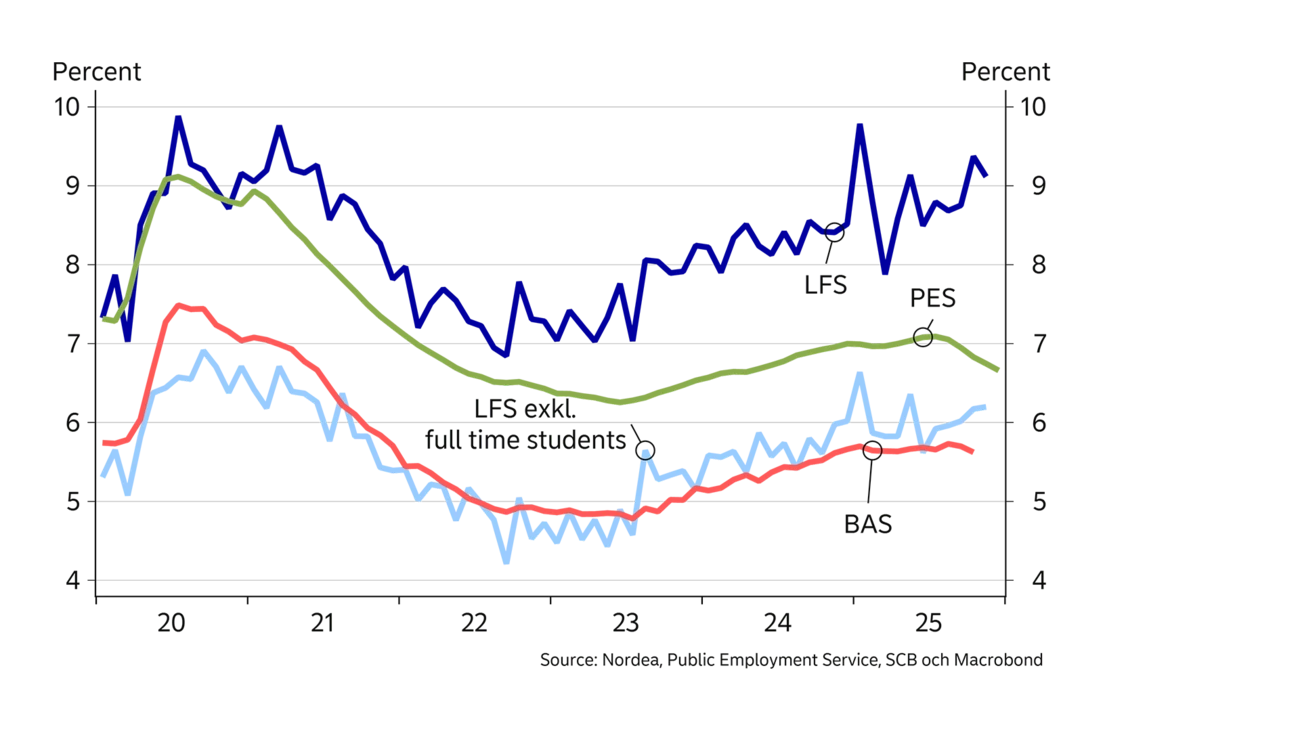
Unemployment according to BAS is preferable
According to both BAS and the LFS, the employment rate has dropped and unemployment has risen, owing to weak demand in the Swedish economy. However, the LFS’ generous definition of a jobseeker means unemployment appears much higher and may overstate the extent of idle resources in the labour market. According to BAS, there are more available resources in the labour market than normal, though less than the LFS indicates. Beyond those registered with the Public Employment Service, there are indeed individuals who can and want to work, but the size of this labour supply is likely limited. It is always important to use complementary measures, but, to capture the core of the available resources in the labour market, the BAS unemployment rate is preferable.
Author

- Name:
- Anna Westlund
- Title:
- Senior Economist, Nordea

Trade finance
How trade polarisation is reshaping global commerce
Global trade isn’t dying; it’s transforming. And for Nordic businesses embedded in international supply chains, understanding this shift is crucial.
Read more
Sustainable finance
CIP acquires Ørsted renewable energy platform in a EUR 1.4bn deal with Nordea providing funding
Copenhagen Infrastructure Partners acquires Ørsted's onshore renewables portfolio in one of Europe's largest renewable energy platform financings.
Read more
Transaction banking
From payments to decisions: The future of Transaction Banking
As payment execution becomes faster and more automated, the real value in transaction banking is shifting from managing individual transactions to orchestrating financial flows in real-time environments.
Read more