This article first appeared in the Nordea Economic Outlook: Northern Lights, published on 21 January 2026.
Read more from the latest reportEconomic Outlook
Strong surge in exports beyond Denmark’s borders
Despite trade tensions and geopolitical turmoil, Danish exports have surged in recent years. Much of this growth stems from exports of goods produced outside Denmark’s borders. However, these still count as exports and have played a key role in Denmark’s stronger economic performance compared to many other countries.

Over the past five years, the value of total Danish exports of goods and services has risen by more than 70%. Even when adjusted for price development, the period shows a real increase of more than 40%. Thus, the rise in net exports has been a major driver of Denmark’s solid economic growth in recent years.
Ways to measure exports
Traditionally, exports are defined as goods and services produced in Denmark and subsequently sold in foreign markets. These are also the figures published in official foreign trade statistics, which follow the border-crossing principle that a transaction must cross the Danish border to be counted as export.
Globalisation – along with the rapid advance of Denmark’s pharmaceutical industry – has sharpened the focus on exports that never cross a physical border. These appear in the balance of payments statistics, which applies the change of ownership principle, defining activity based on where the company is domiciled. This means that sales from branches and subsidiaries of Danish companies located abroad are counted as exports – even if they never cross the Danish border.
A / Strong growth in foreign-produced exports
Goods exports that do not cross the border, DKK in billions
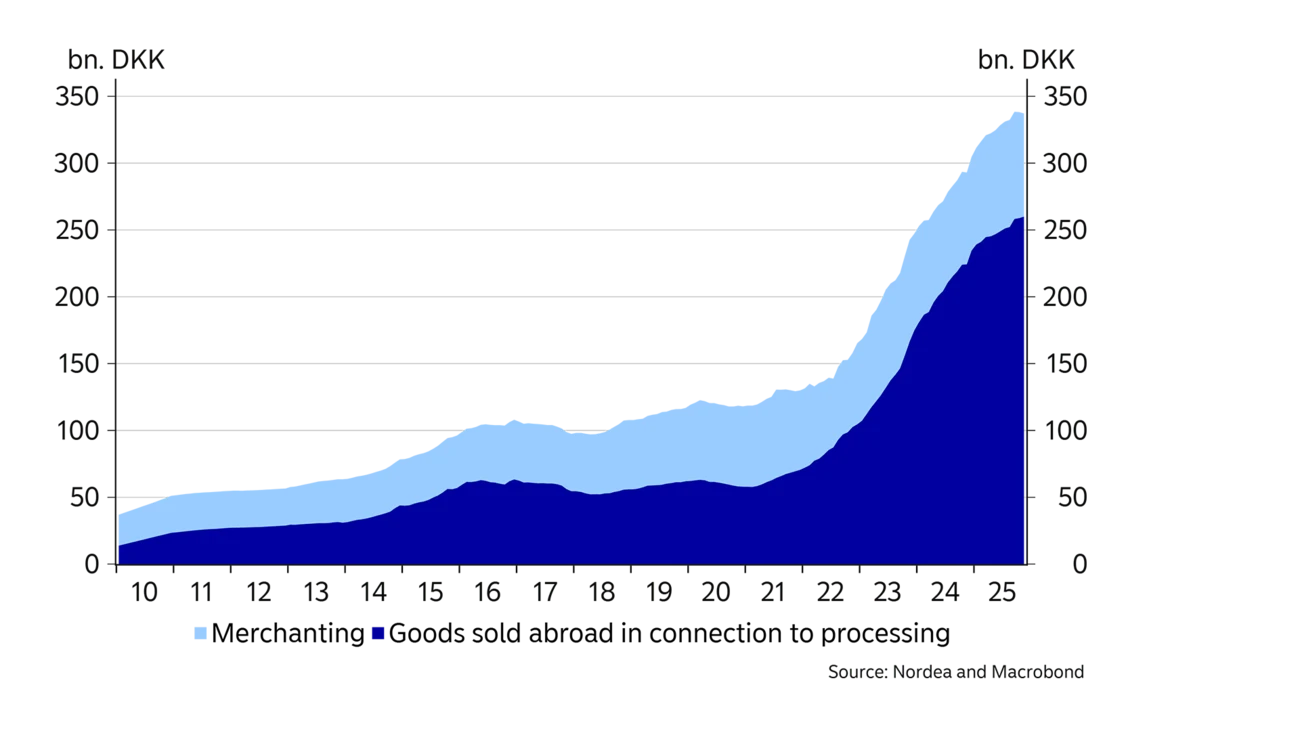
The share of goods exports that do not cross the border falls into two categories. The first is so-called “processing” where goods are processed by a Danish company and then sold abroad. The other is “merchanting” where goods are bought and sold abroad. Together, these two categories generated revenues of DKK 340 billion over the past year alone – accounting for more than a quarter of Denmark’s total goods exports in that period.
An increasing share of exports takes place outside Denmark's borders – making the Danish economy less vulnerable to trade tensions and fluctuations within individual sectors.
Foreign exports provide good protection
A little over one-fifth of total goods exports are sold in the US. That’s twice the level of ten years ago, and over the past four quarters the value of goods exports to the US has exceeded the combined total for Germany and Sweden. Pharmaceuticals make up a substantial share of these exports to the US.
The growing importance of the US market has sparked concerns that higher US tariffs could trigger a sharp drop in exports – ultimately causing an abrupt slowdown in Denmark’s overall economic activity. Preliminary figures, however, show no signs of a significant slowdown in goods exports.
Part of the explanation is likely the trade agreement concluded with the US on 27 July 2025, which – with certain exceptions – imposes a general tariff of 15% on goods exports from EU countries. Another key reason for the continued growth is that around 75% of goods exports to the US are produced outside Denmark’s borders and are thus much better protected against rising tariffs.
Author

- Name:
- Jan Størup Nielsen
- Title:
- Chief Analyst, Nordea

Economic Outlook
New measure of unemployment in Sweden
The Swedish employment rate is among the highest in Europe, yet unemployment is close to 9%, according to the Labour Force Survey. There are strong reasons to take a more nuanced view of unemployment and shift the focus to register-based measures.
Read more
Economic Outlook
Swedish economic outlook: Upswing
Households have regained confidence, and conditions are in place for consumption to substantially increase. The export industry has weathered several global challenges, and the outlook is healthy. The unemployment rate is set to fall to 5%, according to the new BAS measure.
Read more
Economic Outlook
Consumers are critical for growth in Finland
The increase in household saving has kept private consumption subdued in recent years. We examine how alternative assumptions about the savings ratio in the forecast years will affect consumption, employment and economic growth.
Read more