
- Name:
- Marco Kisic
- Title:
- Head of ESG Research, Nordea Equities
Sivua ei ole saatavilla suomeksi
Pysy sivulla | Siirry aiheeseen liittyvälle suomenkieliselle sivulleMarco Kisic
3 min to read
The Carbon Border Adjustment Mechanism (CBAM) is a major milestone for the EU’s green policy, for the first time embedding a CO2 price in several value chains. We surveyed Nordic listed companies to find out about the expected impact.
The Carbon Border Adjustment Mechanism (CBAM) and Emissions Trading System (ETS) reform, which kicked off on 1 January 2026, will for the first time embed a CO2 cost in European materials. Pressure to dilute these policies is surging, making close monitoring necessary, but our base case is that the current design will remain broadly as is until 2030. See Carbon Border Adjustment Mechanism: A new era for European trade and climate policy.
The CBAM covers steel, aluminium, cement and fertilisers, and we estimate it could have a price impact of up to ~20% on EUR 80bn of EU imports by 2030, mostly from steel imports. Materials companies are poised to be the main winners at this stage, and should see utilisation rates going up, alongside some degree of price effect.
Currently the CBAM does not cover imports of products made from these materials. This poses a risk of circumvention and offshoring. For this reason, we expect this “loophole” to be addressed in the future, potentially as early as 2028, as the European Commission has proposed extending the CBAM to a list of 180 downstream products. If this expansion goes through, we estimate a potential impact on imported goods in the low-to-mid-single digits of imported value. Products that could be covered include car parts, domestic appliances and metal tools, among others.
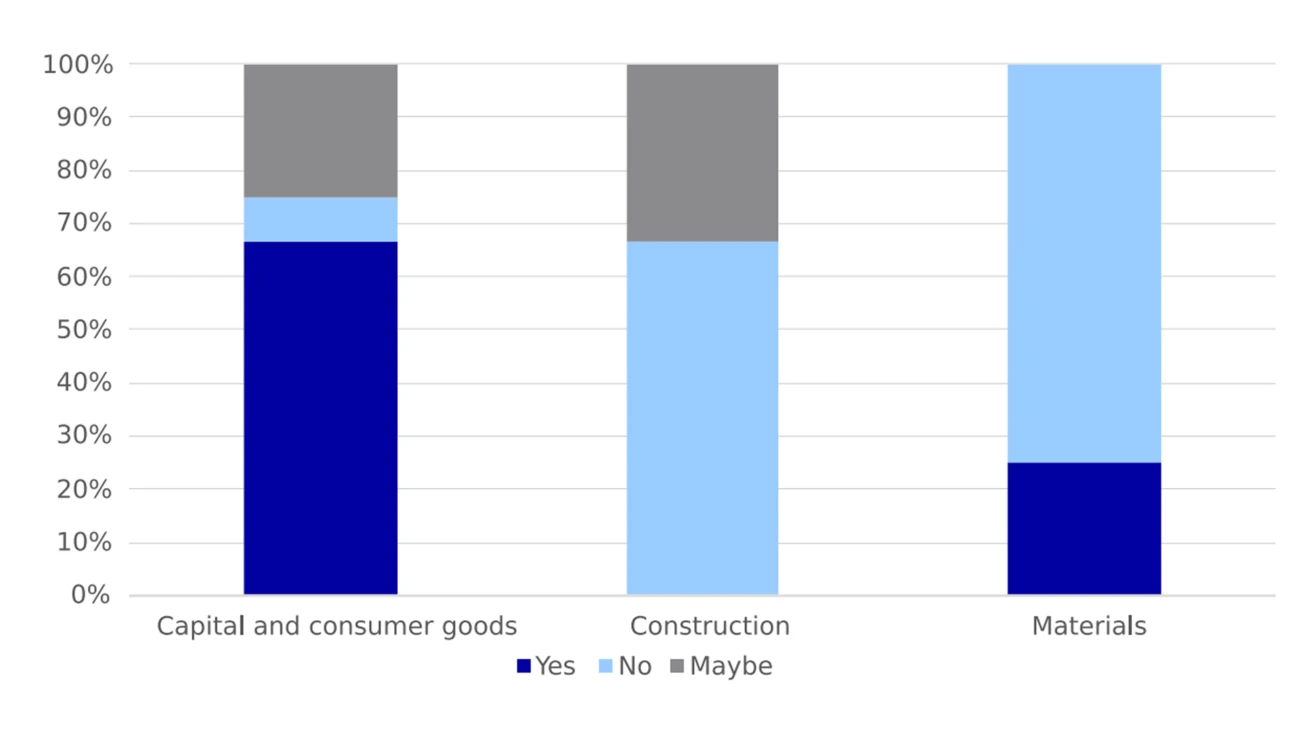
To gain a better sense of the potential impact of the CBAM, we sent out a four-question survey to 40 listed Nordic companies across the capital goods, consumer goods, construction and materials sectors (~50% replied). Overall, the responses point to a good level of understanding of the CBAM, although the full implications are not always clear.
Materials companies view the CBAM as an opportunity, as we expected. Construction companies see the impact as broadly neutral, as most materials are sourced locally in the Nordics. Capital and consumer goods players, on the other hand, see a slight negative risk from somewhat higher input costs, especially if the CBAM is extended to downstream products – a scenario we see as likely, given the asymmetry of the current setup. We estimate a tariff of 3-5% of import values for products on the list, such as washing machines, auto parts and metal parts.
Most companies are already looking at mitigating measures, mostly involving sourcing from EU suppliers instead of non-EU, and some of these initiatives are already under way.
Source: Nordea survey of companies
Against this backdrop, green steel is likely to see a renaissance, and in our static scenario, we estimate price parity as soon as 2029-31. Our green steel supply/demand model points to tightness likely building in hydrogen-based steel in 2028-29. We expect reshoring and the green premium to also drive power demand in the EU; we estimate a 1-2% increase by 2030 owing to the switch from blast furnaces to scrap-/hydrogen-based steel alone.
Sustainability
From January 2026, the EU's Carbon Border Adjustment Mechanism fundamentally changes how carbon costs affect global trade, creating new challenges and opportunities for companies across carbon-intensive industries.
Read more
Register below for the latest insights from Nordea’s Sustainable Finance Advisory team direct to your mailbox.
Read more
Sustainability
From January 2026, the EU's Carbon Border Adjustment Mechanism fundamentally changes how carbon costs affect global trade, creating new challenges and opportunities for companies across carbon-intensive industries.
Read more
Economy
Oil prices have surged from USD 60 to nearly USD 120 per barrel amid Middle East tensions, but the Nordic economies are expected to remain resilient. Our analysis shows the economic impact should be manageable if prices stabilise around current forward market expectations.
Read more
Sustainable finance
You might have come across the term “green loans” and wondered how financing can be categorised based on its environmental features. In this short explainer, we examine the mechanisms behind this type of loan.
Read more