Highlights:
- Solid GDP growth.
- Broad-based expansion.
- Resource utilisation rises.
- Inflation and monetary policy normalise.
- Unemployment projected to fall to 5.0% in mid-2027 (BAS).
The Swedish economy has normalised. Resource utilisation is currently at the historical average and should continue to rise over the coming year. Growth is being driven by both stronger exports and firmer domestic demand. Unemployment is falling, while inflation will rise to around 2% next year. The Riksbank raises its policy rate, and the SEK exchange rate gradually appreciates over the forecast period.
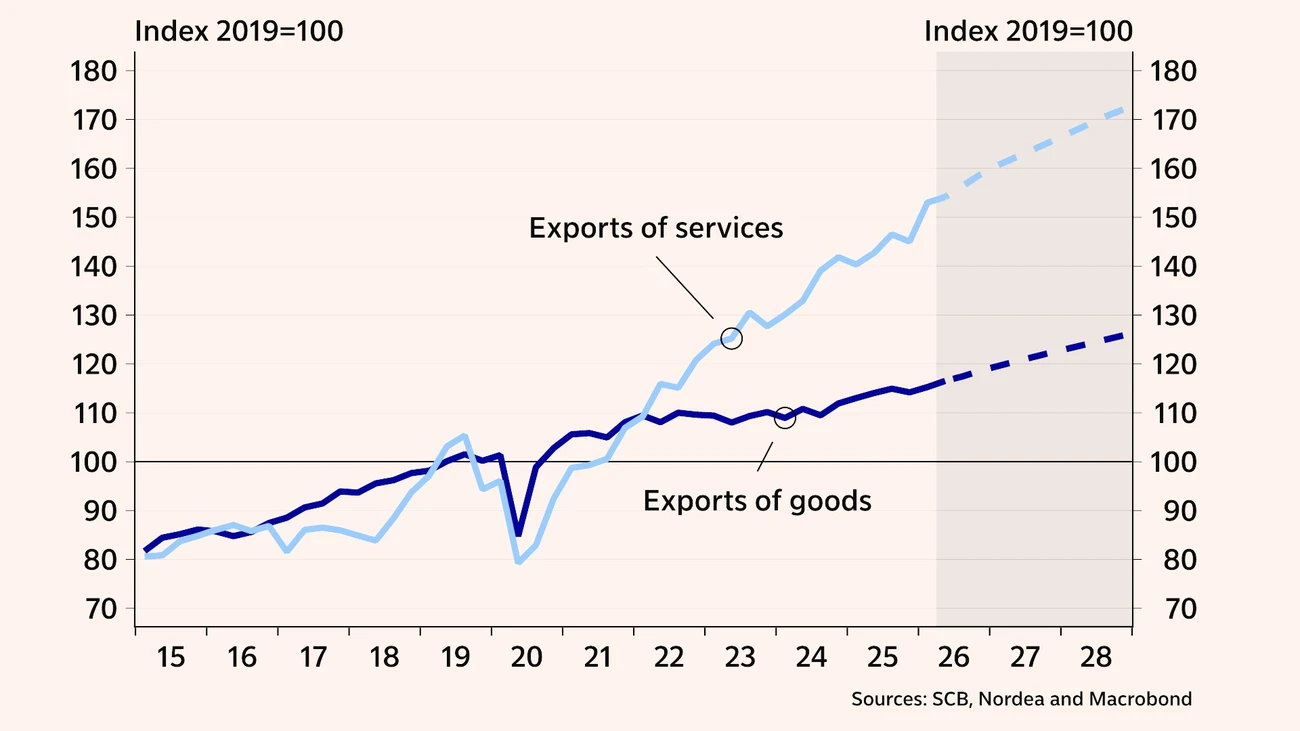
The Swedish economy is expanding across a broad front. Its competitive manufacturing industry is increasing goods exports, while services exports are becoming an increasingly important part of the economy. Households began to regain their footing as early as 2024, and the recovery in consumption is now well under way. Conditions are in place for domestic demand to continue expanding, with an additional near-term boost from a generous fiscal policy. Our forecast implies that employment will rise from an already high level.
It is important to remember that Sweden’s potential and long-term GDP growth rate is now lower than before the pandemic. The reason is that population growth has stalled. Consequently, it requires less GDP growth today than in the past to lift resource utilisation. The economy has normalised and, given the projected GDP growth, resource utilisation will run slightly above normal in the coming years; see the special theme on page 26.
Inflation will rise going forward, prompting the Riksbank to increase its policy rate. Together with less expansionary fiscal policy after the 2026 election year, the overall policy stance becomes more neutral. Higher resource utilisation also makes it more difficult to generate growth. Therefore, GDP growth is likely to slow, and during the latter part of the forecast period the Swedish economy should expand in line with its long-term trend, i.e. by around 1.75%.
The global as well as the Swedish economy has shown unexpected resilience in recent years. Even so, risks associated with a turbulent external environment remain. If conditions deteriorate, uncertainty could cause Swedish households and businesses to hesitate before consuming, investing and hiring. There is also scope for stronger growth, especially if households use more of their improved financial position to increase consumption.
7.0
Trillion SEK, the forecast for GDP 2026 in current prices
1.4
Percentage point, the difference between CPIF and CPIF with constant taxes year-on-year, July 2026
42%
Share of full-time students among the unemployed in H1 2026, according to LFS
Households have loosened their purse strings over the past two years, but spending appetite has not yet fully returned to the trend seen before the pandemic, and before the inflation and interest-rate shock struck in 2022.
The consumption gap is closing. Household debt relative to disposable income has fallen by as much as 25 percentage points in five years. This means that households have come a long way in adjusting to higher interest rates, which in turn probably is the single most important reason why their high saving rate has started to decline. Consumer confidence is also recovering, purchasing power is improving markedly and households are borrowing again. Credit growth currently stands at SEK 15bn per month, or around 4% annualised. This is in line with long-term nominal growth in income and can therefore be regarded as normal.
| ‘25 | ‘26E | ‘27E | ‘28E | |
|---|---|---|---|---|
| Real GDP (calendar adjusted), % y/y | 1.6 | 2.8 | 2.5 | 1.8 |
| Underlying prices (CPIF), % y/y | 2.6 | 1.4 | 1.9 | 1.8 |
| Unemployment rate (LFS), % | 8.8 | 8.5 | 7.8 | 7.4 |
| Unemployment rate (BAS), % | 5.5 | 5.2 | 5.0 | 5.0 |
| General gov. budget balance, % of GDP | -1.6 | -1.7 | -2.0 | -0.5 |
| General gov. gross debt, % of GDP | 35.2 | 34.8 | 35.6 | 35.3 |
| Monetary policy rate (end of period) | 1.75 | 2.00 | 2.25 | 2.25 |
| EUR/SEK (end of period) | 10.83 | 11.00 | 10.80 | 10.70 |
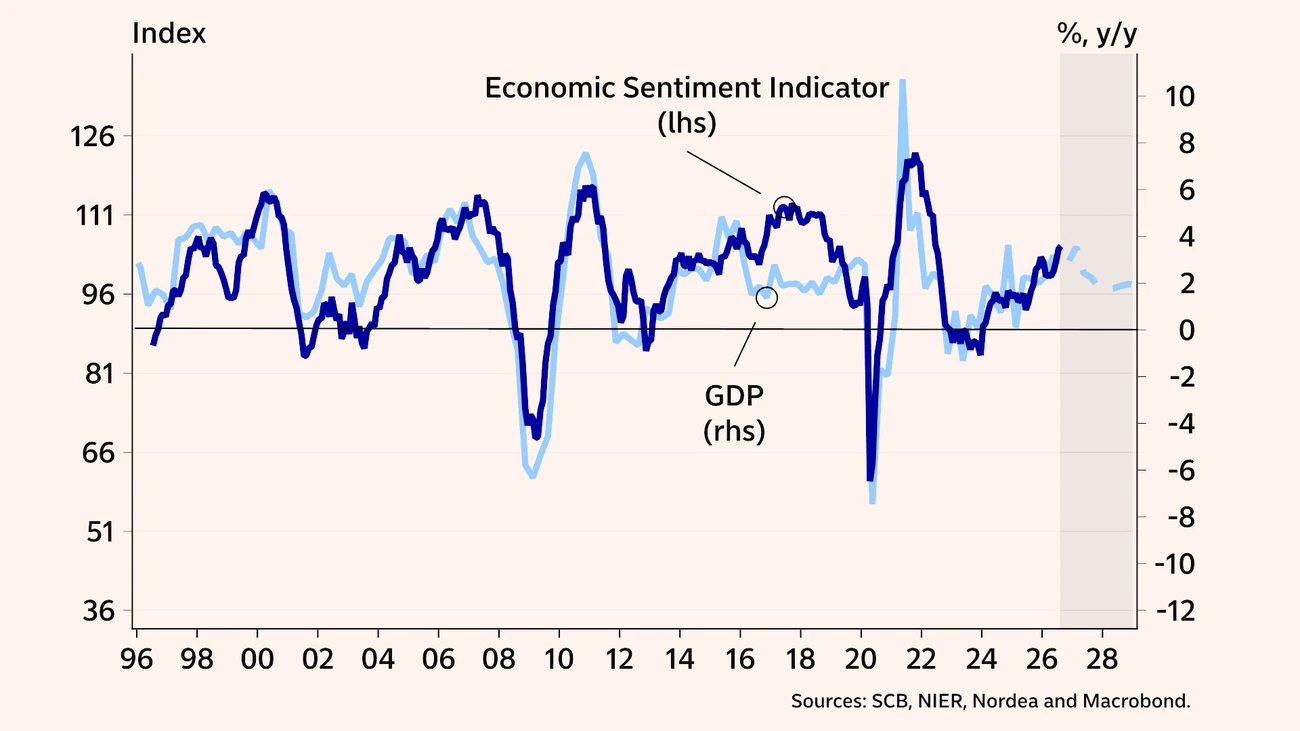
It’s a broad-based upturn in the Swedish economy.
Our forecast implies only a modest decline in the saving rate, i.e. the share of income that households save. The upside potential we see for households is largely based on the possibility that savings could fall more than assumed in this forecast. In a more favourable scenario, with an improved global backdrop and higher employment, lower precautionary saving would free up more scope for an even stronger increase in consumption.
The housing market is driven by many of the same factors as household consumption. However, house prices are recovering somewhat more slowly because home purchases are even more sensitive to interest rates, which remain clearly higher than in the years before and around the pandemic. Housing supply is also abundant. Turnover in the housing market has normalised and excess supply is declining, but it still restrains price growth, especially in the near term. We forecast house prices will rise by 4–5% in each forecast year.
One reason household income is rising rapidly this year is the unusually generous fiscal policy in the 2026 election year. This year’s unfunded fiscal measures correspond to around 1.5% of GDP. In addition, higher defence spending provides an extra boost to GDP growth, increasing by around 0.5% of GDP per year. This gives an indication of the impact on GDP, although the defence spending will also raise imports. The budget deficit will reach almost 2% of GDP this year.
At the time of writing, Sweden’s general election has not yet taken place. We expect fiscal policy to become significantly more restrained in 2027 and 2028 than this year, regardless of which government takes office. Most parties are committed to the fiscal policy framework, leaving limited scope for unfunded measures. This means that the budget deficit, excluding defence expenditure, will decline in the years ahead. General government debt under the Maastricht definition is likely to remain around 35% of GDP.
Expansionary fiscal policy, and defence initiatives in particular, are lifting public consumption and fixed investment. Construction companies have been optimistic about the outlook for some time and this now appears to be translating into an actual improvement in construction activity. This is happening even though residential construction is, and is likely to remain, modest because of low population growth.
Investment is also increasing in other sectors. The private services sector has maintained a decent pace since the pandemic despite higher interest rates and inflation. Improved sentiment in the sector suggests that the investment upswing will continue. Industry has expanded as well, illustrating the breadth of the Swedish economic upturn.
In the first half of this year, goods exports to the US fell by 10% compared with a year earlier in current prices. Even so, total exports increased. This probably reflects both the flexibility of Swedish exporters, who are increasing sales in other markets, and the greater-than-expected resilience of global trade. The new trade agreements that the EU has concluded with a number of countries and regions have facilitated the shift towards new markets.
Indicators for Swedish goods exports are upbeat for the next few quarters and we expect the upswing to continue. This is also consistent with the outlook for other countries in this economic report. In addition, we expect the increasingly important services exports, which now account for 18% of GDP, to maintain a solid trend going forward
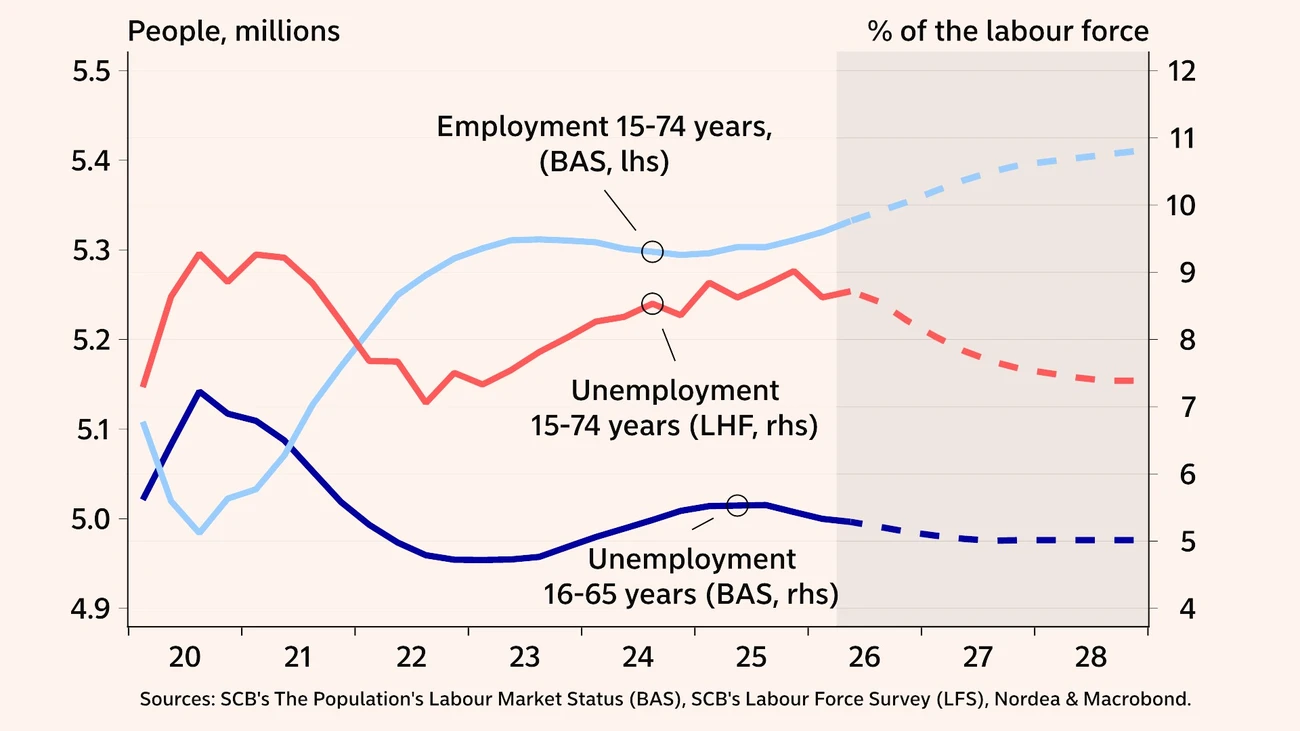
Labour market conditions have improved over the past year. Employment has risen and unemployment has declined.
Labour market developments are somewhat mixed. Figures from the Population’s Labour Market Status (BAS) show a stronger trend than the Labour Force Survey (LFS), both in employment and unemployment. The number of newly registered vacancies is low according to the Swedish Public Employment Service, while Statistics Sweden’s quarterly survey shows a considerably higher level. Companies’ hiring plans have been surprisingly stable in recent years despite fluctuations in employment growth.
We attach particular weight to the fact that GDP growth has been, and is projected to remain, solid. This is a strong argument for labour demand to continue increasing over the forecast period. Therefore, we expect the gradual improvement to continue in the coming years. By the end of 2027, unemployment should fall to 5.0% according to BAS and to 7.5% according to the LFS, before levelling off.
Wage growth has gradually slowed from a peak of 4.1% in 2024 to 3.5% in 2026, measured as annual averages. The next major round of wage negotiations concludes in spring 2027. Low inflation this year points to lower settlements, while the stronger labour market pulls in the opposite direction. We expect agreements to be just below 3% per year. Including some wage drift, this implies total wage growth of slightly above 3% per year for 2027 and 2028. This is higher than before the pandemic, when wage growth was stable at 2.5%, but can be regarded as consistent with the 2% inflation target.
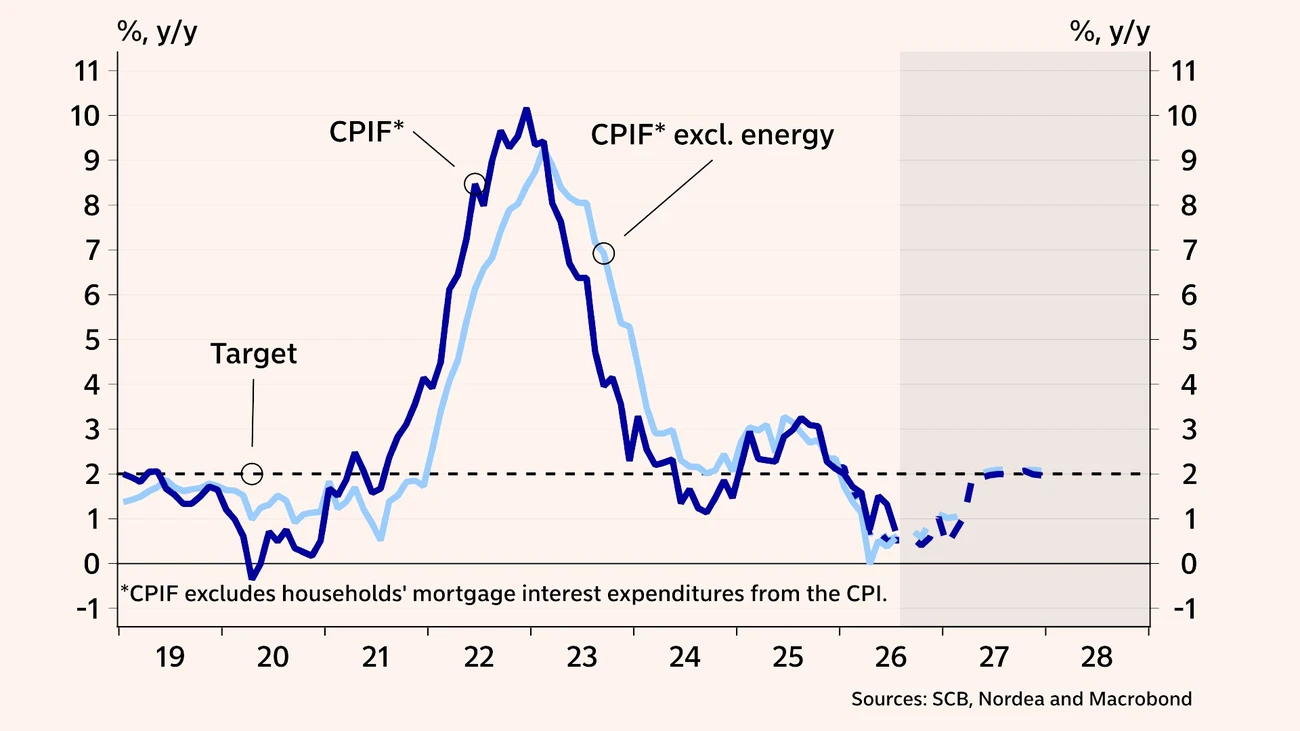
There are a lot of things going on for inflation in 2026. Above all, an unusually large number of temporary tax cuts are lowering inflation, including on food, fuel and public transport. Even excluding all temporary effects, underlying inflation pressure is modest. This is illustrated by the CPIF excluding energy and at constant taxes, which averaged 1.4% year-on-year from January through July this year.
Inflation is set to rise going forward. Some of the temporary tax cuts will be reversed, while the SEK exchange rate has weakened this year. Global price impulses are also emerging through higher transport costs and rising prices for some goods, such as consumer electronics. Electricity prices look set to increase over the winter. This is also a global effect, as higher gas prices on the Continent spill over to Sweden through higher electricity bills. As a result, CPIF inflation, the Riksbank’s preferred measure, could rise but remain close to the 2% target. Together with higher resource utilisation in the economy, this justifies a normalisation of monetary policy by the Riksbank.
The SEK has weakened this year. Given moderate inflation pressure in Sweden, the Riksbank has kept its policy rate unchanged while rates have been raised elsewhere. Relatively low domestic interest rates have weighed on the exchange rate. The SEK also tends to suffer when global conditions are turbulent.
The outlook for the SEK is uncertain. The exchange rate also matters for the Riksbank, prompting rate hikes. In addition, several fundamental factors support the SEK going forward, including relatively solid growth prospects and robust public finances. Our main scenario therefore envisages a gradual appreciation of the SEK against both the euro and the dollar.
This article first appeared in the Economic Outlook: Resilience in motion, published on 2 September 2026.
Read more from the latest Economic Outlook
Stay ahead of the curve with our expert economic insights and forecasts. Get the latest analysis on global and Nordic markets delivered straight to your inbox.
Read more
Teknologinen kehitys on pystynyt kompensoimaan geopoliittisen epävarmuuden negatiiviset vaikutukset talouteen, ja maailman kasvuvauhti on säilynyt ripeänä.
Read more
Economic Outlook
Finland’s long period of weak productivity growth finally appears to be easing. Part of the turnaround reflects a better cyclical backdrop, but the drivers of longer-term productivity growth have also strengthened.
Read more
Economic Outlook
The Finnish economy has grown broadly in the first half of the year. Growth has been seen in private consumption, investment and exports alike. We expect growth to continue despite higher fuel prices and interest rates caused by the Middle East crisis. The recovery is expected to pass through to the labour and housing markets with a lag.
Read more