Ursäkta...

Den här sidan finns tyvärr inte på svenska.

Stanna kvar på sidan | Gå till en relaterad sida på svenska

Key takeaways:

  • A sustained increase in renovation volumes will largely depend on incremental subsidies.
     
  • Regions with rental bans could see “brown discounts” widening, referring to the growing price gap between energy-efficient and energy-inefficient properties.
     
  • We expect a shift from standalone measures to extensive renovations, with a focus on properties in bottom energy classes.
     
  • Insulation companies, renovation professionals and heat pump manufacturers stand to benefit.

By 29 May 2026, EU member states were required to transpose the “EU renovation wave” Energy Performance of Buildings Directive (EPBD) into their national laws. Many of them missed the deadline, but we expect that by the end of the year, most of them will have completed the transposition. As part of the process, countries have to legislate on specific items, including a definition of the minimum energy performance standards (MEPS) and a harmonisation of the Energy Performance Certificate (EPC) systems.

Uneven progress across the EU

The progress on the transposition is not consistent, with several countries still far from completion. France is among the few countries that has already completed the transposition process, and we take a closer look at the national renovation trends there for clues as to what the impact of the EPBD implementation might be once implemented across the EU.

In the Nordics, the EPBD implementation leverages extensively on existing legislation, which to some degree is already aligned with the ambition level of the EPBD; however, the details are still being ironed out. Denmark, Finland and Sweden are among the EU countries that have already submitted draft renovation plans to the Commission. In Sweden, the process to define MEPS levels is still ongoing, and finalisation is likely to take several more months. Denmark and Finland are at an advanced stage, with strong renovation governance already in place. Norway is outside of the EU track, although as a member of the EEA, it is likely to align to the EPBD, just with more flexible timelines.

The French example

In recent years, France has introduced an advanced regulatory framework for energy efficiency in buildings, providing an example of early EPBD adoption. It has strong MEPs in place, a well-developed EPC system and rental bans for low energy efficiency residential buildings.

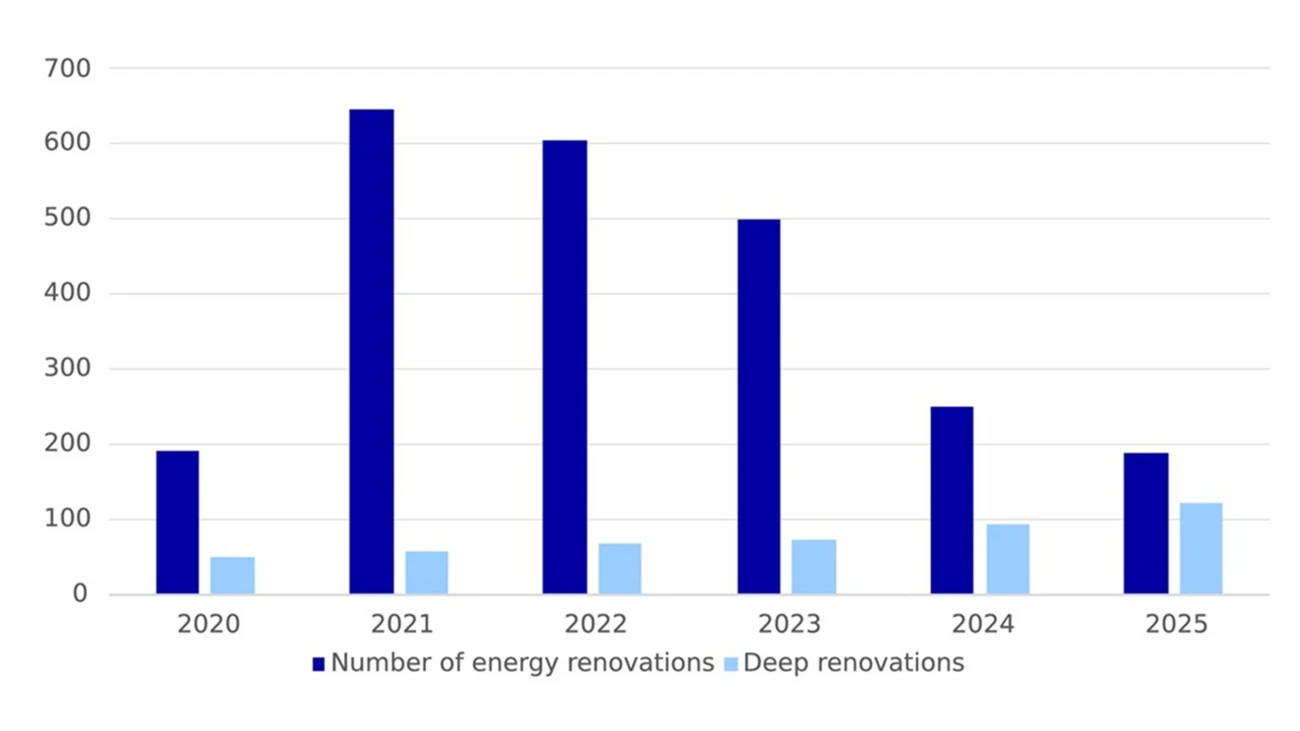
When looking at the impact of this regulatory push on renovation trends, the effects appear mixed. It successfully shifted renovations from standalone measures to deep renovations and boosted renovations of bottom-rated properties. However, the total volumes and investment in energy renovations declined, impacted by inflation and changes in subsidy plans, and due to the complexity of moving from single renovations to more comprehensive ones.

Chart: Number of properties renovated via subsidy schemes

Source: ADEME and Nordea

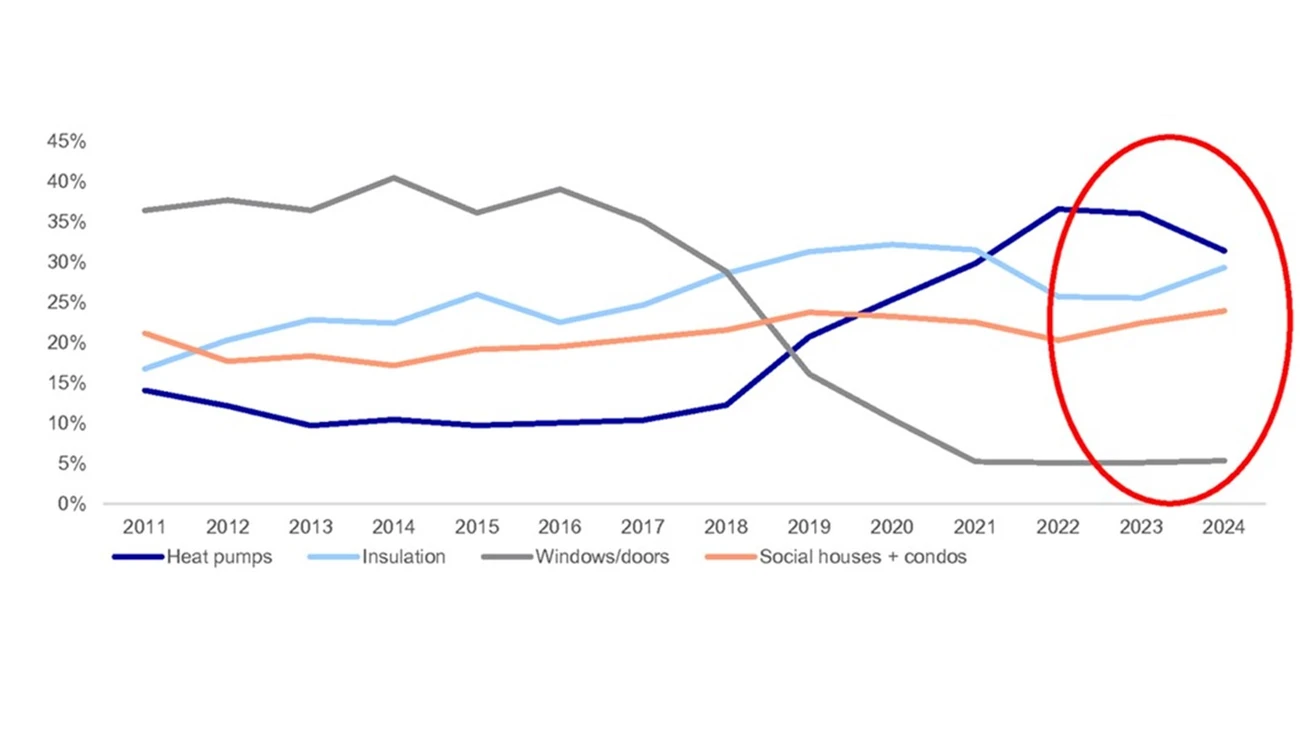
Our analysis shows that since 2022 – when the EPC system was reformed and policy emphasis moved toward deep renovations and G/F classes – insulation and entire building renovations took a larger share of the total spend. Heat pumps took a hit, mostly as a result of changes in subsidy schemes and lower energy prices, but possibly also as a result of the shift away from single measures. Looking forward, we expect any increase in the overall renovation subsidy pool to benefit heat pump manufacturers, which should also benefit from the ban of gas boilers in newbuilds (public: 2028, all: 2030).

Chart: Energy renovations in France – Share of total spend captured by selected measures (% of total spend in that year)

Source: ADEME and Nordea

Rental bans and impact on property values

France has introduced rental bans for class G properties from 2025, and will ban class F from 2028 and class E from 2034. Overall, the ban had a mixed effect. While it partly improved renovation rates, it also reduced the rental supply as many owners could not or did not want to renovate, and either withdrew the property from the market or sold. This increased the discount for G-homes, with some sources putting the resulting "brown discount" to somewhere between 5-20% depending on the energy class, location and sector. We are of the view that a "brown discount" is likely to stick and become a structural feature of EPBD-compliant markets.

Conclusions

We expect the implementation of the EPBD over the next six months to kick-start a progressive shift in the type and possibly quantity of renovations. Based on the French example, the emphasis will likely shift to larger projects and bottom properties, and insulation could be taking a larger share of the total investment spend, while the role of professional installers and energy consultants is likely to grow. The extent to which the EPBD will lead to a pick-up in overall energy renovation volumes will depend on subsidy schemes as well as coercion measures, such as the rental bans seen in France.

What is the EPBD?

The EU’s Energy Performance of Buildings Directive introduces binding energy efficiency mandates in national building stocks for the first time. In particular:

  • Non-residential buildings: 16% of the worst-performing buildings must be renovated by 2030, and up to 26% by 2033.
     
  • Residential buildings: Average primary energy use must fall by 16% by 2030 and 20-22% by 2035, with at least 55% of that reduction coming from renovating the worst-performing homes.
     
  • New buildings: Zero-emission standards apply to all new buildings from 2030 (2028 for public buildings). 

Regarding gas boilers, the EPBD states that from:

  • 2025 (subsidies): Subsidies and financial incentives for stand-alone fossil fuel boilers are officially discontinued.
     
  • 2028 (public buildings): New gas boilers can no longer be installed in public-authority buildings (e.g., offices, schools, and civic facilities).
     
  • 2030 (new construction): All newly constructed buildings must be zero-emission, meaning no on-site carbon emissions from fossil fuels.
     
  • 2040 (phase-out): Member states are legally required to have implemented national phase-out plans to completely eliminate fossil fuel boilers. 

29 May is the deadline for the EPBD transposition into national law. As part of this, the key provisions that countries have to legislate include:

  • Minimum Energy Performance Standards (MEPS): this is the core of the EPBD and defines the thresholds below which buildings must be renovated (16% and 26% for non-residential, and national trajectories for residential buildings).
     
  • Energy Performance Certificates (EPC): the system will need to be standardised across the EU, with class A representing zero energy buildings.
     
  • Zero emission buildings (ZEB): a step-up from the current near-zero energy building, a ZEB is generally defined as a building with very high energy efficiency, no on-site fossil fuels and energy demand covered by zero-emission energy.
     
  • Global Warming Potential (GWP): requirement to estimate and disclose the full life-cycle emissions of new buildings >1000 sqm in area from 2028, and all newbuilds from 2030.
     
  • Building automation and control system (BACS): countries must ensure that commercial buildings with technical systems above 290kW (70kW from 2030) have a BACS. 

Following the transposition into national law, by the end of 2026, countries have to submit national building renovation plans (NBRP) outlining the path towards achieving the goal of zero-emission buildings by 2050, and providing details of the national targets and strategies.

 

Author

Name:
Marco Kisic
Title:
Head of ESG Research, Nordea Equities
After reading this article, is your perception of Nordea? (Required)
* Required fields are shown with an asterisk.
Energy storage OX2

Insights

OX2: Combining wind and battery storage to strengthen the Nordic energy system

Nordea recently supported OX2 in securing project financing for two co-located battery energy storage systems with a combined capacity of 235 MW/470 MWh, integrated with the company's new onshore wind portfolio in Finland.

Read more
Windmill_farm

Sustainability

What is ESG?

ESG stands for Environmental, Social and Governance. ESG frameworks are used to assess how companies manage sustainability-related risks and opportunities alongside traditional financial factors.

Read more
Antti Saha, Head of Large Corporates & Institutions Finland at Nordea

Our people

Meet our people: Antti Saha on jazz band banking and Finland’s growth momentum

Finnish corporates are shifting gears: from building solid foundations and profitability to pursuing growth. Antti Saha, Head of Large Corporates & Institutions in Finland, explains what’s driving the shift, and why he compares his role to conducting a jazz band.

Read more