Key takeaways:
- Slightly slower growth in the Norwegian economy
- Inflation still too high
- Norges Bank hikes once more and does not cut until 2028
Den här sidan finns tyvärr inte på svenska.
Stanna kvar på sidan | Gå till en relaterad sida på svenskaUnderlying inflation is likely to pick up again after its summer decline and remain around 3% through year-end. Inflation is therefore still where it was two years ago, while unemployment remains low. Norges Bank has not yet reached its inflation target and has sharpened its focus on bringing inflation down. We therefore expect it to raise the policy rate once more this autumn and then stay put until it is fully confident inflation is approaching the target. It will therefore take time before rates come down again. Slightly higher rates and a gradual decline in petroleum investment will weigh on growth ahead and lift unemployment modestly. The krone may strengthen somewhat, although more against the dollar than the euro.

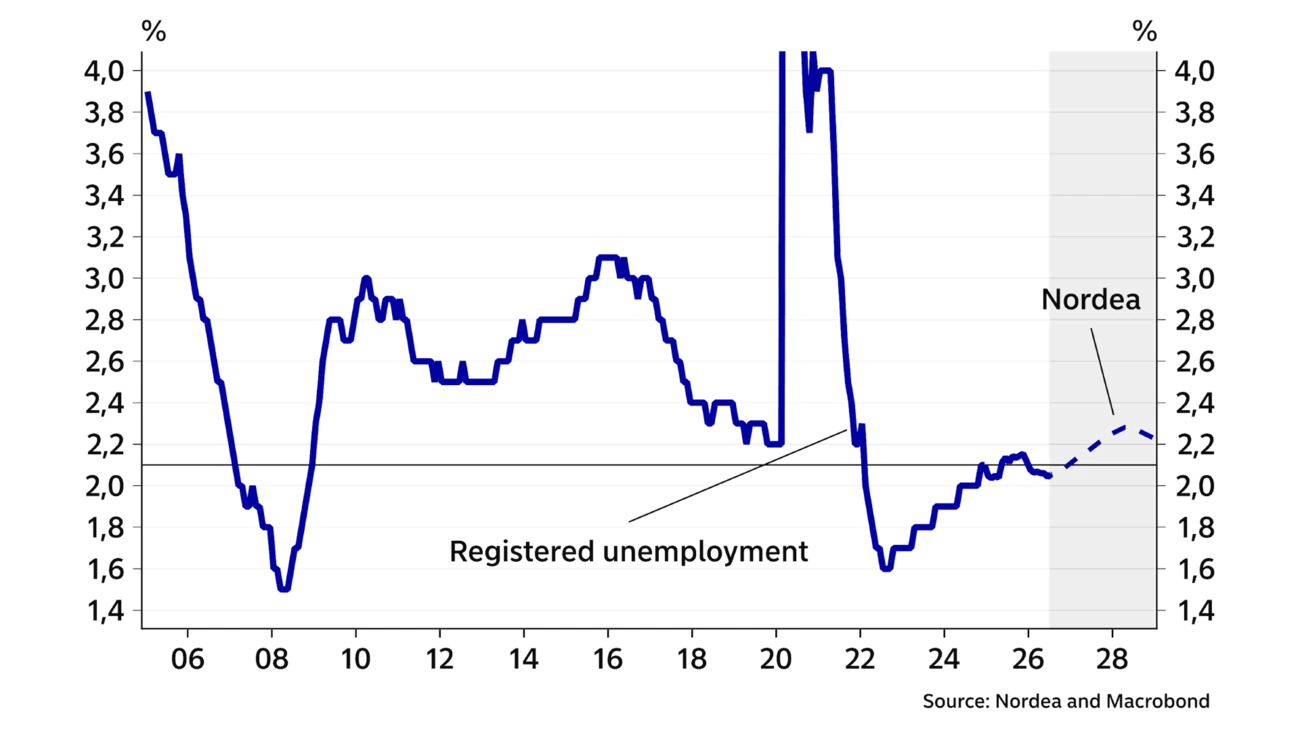
After growth in the Norwegian economy picked up to slightly above last year’s trend, there are signs that it has slowed somewhat so far this year. Companies have reported slightly lower capacity utilisation and somewhat easier access to labour. Registered unemployment has nevertheless remained low at around 2%, and is slightly lower than last year. At the same time, labour demand remains strong and the number of vacancies has increased. Overall capacity utilisation in the Norwegian economy is probably still close to a normal level. The period ahead will most likely be characterised by somewhat lower capacity utilisation and a moderate rise in unemployment.
Norges Bank’s U-turn is contributing. By taking back last year’s two rate cuts, borrowers will, all else equal, have somewhat less disposable cash flow. Slightly higher rates may also encourage more saving. Norwegian households’ purchasing power is still expected to increase this year, but by less than in the previous two years. With wage growth of around 4.5% this year and overall consumer price inflation estimated at just above 3%, real wages are still rising solidly. Higher rates dampen the increase in purchasing power, but by no means eliminate it. We also expect fairly strong real wage growth over the next few years. Consumption should therefore continue to grow at a decent pace, although not as strongly as before.
At the same time, petroleum investment will almost certainly decline gradually over the next few years. Activity in petroleum-related industries is currently very high, reflecting the tax incentives introduced during the pandemic and the subsequent sharp rise in new field developments. Although the pipeline of new projects remains fairly large, it is unlikely to match the size of the projects now nearing completion. We do not expect activity to come to an abrupt halt, however, and persistently high oil prices could soften the slowdown somewhat.
There are also factors supporting growth. Despite considerable global uncertainty, exports from mainland Norway have risen strongly on the back of solid market growth and a weak krone. The persistently weak krone, the climate and Norway’s reputation as a safe travel destination have also contributed to a sharp rise in tourism. External market growth is expected to remain solid, and growth is set to pick up among several of Norway’s most important nearby trading partners. At home, government spending has increased substantially in recent years, and the political situation suggests little scope for a marked slowdown in spending growth ahead.
| ‘25 | ‘26E | ‘27E | ‘28E | |
|---|---|---|---|---|
| Real GDP (mainland), % y/y | 1.7 | 1.0 | 1.1 | 1.5 |
| Household consumption | 2.7 | 1.2 | 1.5 | 2.0 |
| Core inflation (CPI-ATE), % y/y | 3.1 | 3.1 | 2.7 | 2.4 |
| Annual wage growth | 4.9 | 4.6 | 4.0 | 3.8 |
| Unemployment rate (registered), % (average) | 2.1 | 2.1 | 2.2 | 2.3 |
| Monetary policy rate (end of period) | 4.0 | 4.5 | 4.5 | 4.0 |
| EUR/NOK (end of period) | 11.8 | 11.00 | 10.75 | 10.75 |
1.0%
Forecast for mainland GDP growth in 2026
2.2%
Forecast for registered unemployment rate at end-2028
4.5%
Forecast for policy rate at end-2027
Public sector demand is therefore expected to remain robust. Increased spending on defence and emergency preparedness is generating positive spillovers across the Norwegian economy, including services, construction and manufacturing. Investment in power generation and data centres will also support growth. Despite persistently weak new construction of both residential and commercial buildings, the construction sector as a whole actually expects some growth ahead.
Overall, growth in the mainland economy and employment this year and next is expected to be somewhat lower than we saw last year, and close to, though probably marginally below, growth in the economy's production potential. A large initial number of unfilled vacancies may help dampen the impact on the labour market. Registered unemployment may rise somewhat, but probably not by much. In 2028, we expect growth to pick up again slightly, mainly as a result of a moderate decline in interest rates as inflation gradually approaches 2%.
Growth in house prices has slowed across most major Norwegian cities during 2026. Regional differences are substantial, but slightly higher mortgage rates appear to be dampening growth, particularly in Oslo, where the number of unsold homes is at its highest since the year before the financial crisis. An increased supply of homes previously used as rentals is also contributing materially to the relatively weak development in the capital. Another rate hike from Norges Bank will raise households’ interest burden and probably make buyers more cautious in bidding rounds. If house prices follow a normal seasonal pattern for the rest of the year, the twelve-month growth will fall to around 1.5% in December. This suggests house price growth will slow further during the autumn.
Norges Bank’s U-turn also means that the recovery in housing construction will be delayed. Housing starts have only just begun to pick up and remain moderate. At the same time, new-home sales have weakened somewhat in recent months. This could cause housing starts to fall back again.
Construction costs have risen more than existing-home prices in recent years, making new homes expensive relative to existing ones. New-home sales are unlikely to increase much until the price gap between new and existing homes narrows. With interest rates around current levels, there is little prospect of a sharp rise in existing-home prices. We also expect construction costs to rise marginally more than house prices next year. The profitability of new housing projects is therefore unlikely to improve much, holding back construction. In 2028, we expect somewhat lower rates to support stronger house price growth and greater optimism. That should also improve the profitability of new housing projects and eventually give construction some momentum. By then, developers may also have cut new-home prices so that they better reflect market land values. Persistently higher interest rates have rather clearly made a plot of land worth less today than when it was bought or valued a few years ago.
A plot of land is worth less today than when it was bought or valued a few years ago.
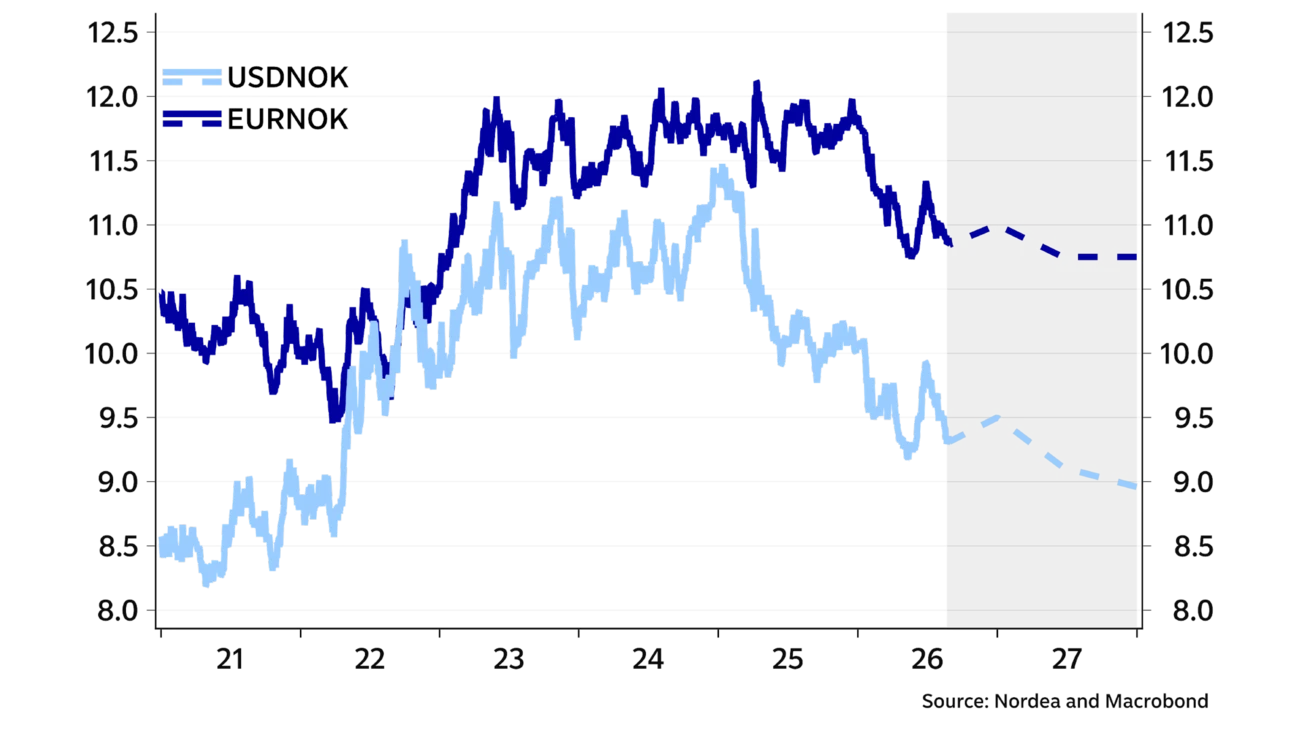
Higher oil prices and krone purchases by Norges Bank helped strengthen the krone by almost one krone against both EUR and USD during the first five months of the year. Oil prices then fell and the krone weakened again throughout June on hopes of a resolution to the Iran conflict. Over the summer, the krone strengthened again, partly as tensions in the Middle East escalated and oil prices rose, but also because Norges Bank significantly increased its daily krone purchases between June and July. Both factors have increased demand for the krone.
We expect the NOK to weaken somewhat against the euro towards the end of the year. Uncertainty surrounding the war in Iran, and consequently the outlook for oil prices and the NOK, remains significant. A lower oil price would, all else equal, weigh on the NOK. Somewhat lower NOK purchases by Norges Bank are also likely to have a weakening effect.
A further rate hike from Norges Bank would work in the opposite direction. Overall, however, we believe the risks in the near term are tilted towards a slightly higher rather than lower EURNOK.
Over the longer term, we expect the NOK to strengthen somewhat, primarily against the US dollar. We expect the dollar to weaken further going forward; see the Global Overview chapter for a more detailed discussion. Historically, a weaker dollar has often coincided with a somewhat stronger NOK against other currencies as well, including the euro. However, we only expect EURNOK to move to slightly below 11.
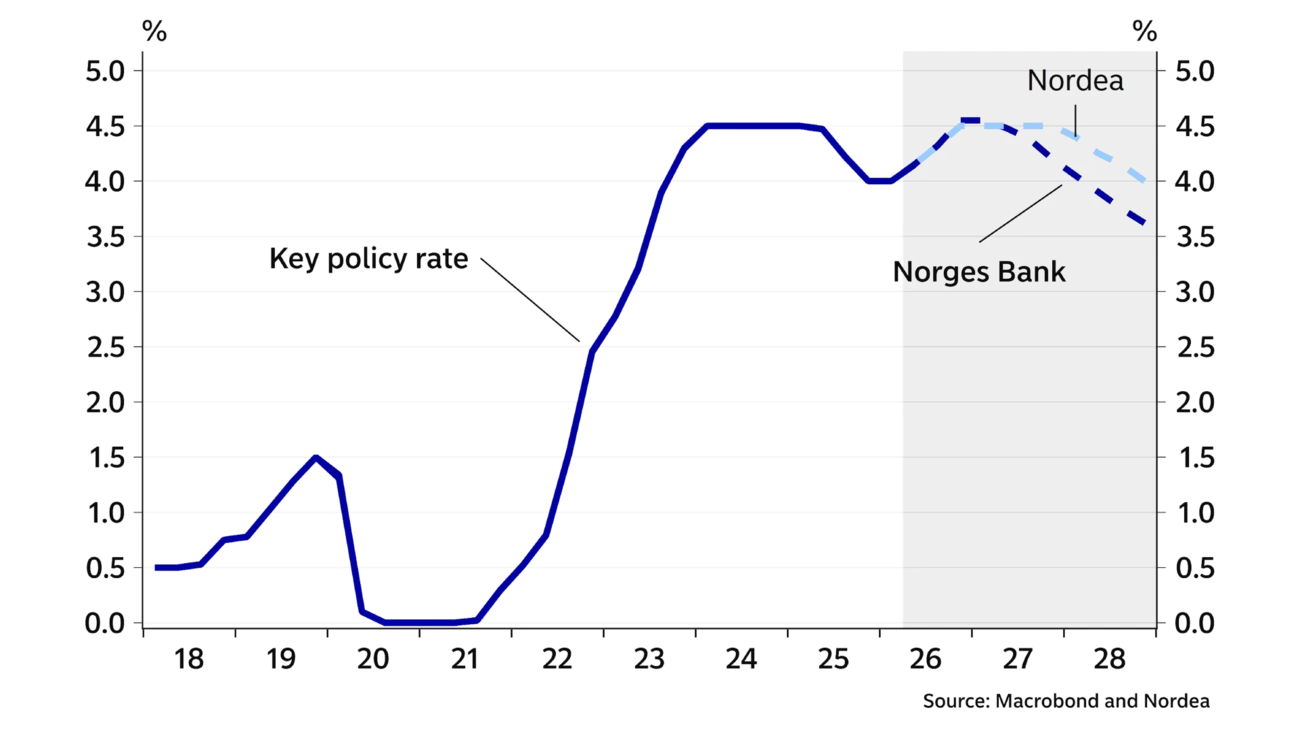
Last year, Norges Bank cut the policy rate twice, from 4.5% to 4%, on the expectation that underlying inflation would gradually decline from around 3%. Developments during last autumn and into the new year showed the opposite: inflation edged higher. Registered unemployment also fell somewhat rather than rising slightly as the Bank had projected. On top of this, the Iran war and higher oil prices and freight rates increased the inflation risks ahead.
Norges Bank therefore reversed course in March, signalling that rates would rise again rather than continue lower. It raised the policy rate to 4.25% in May and said in June that it would most likely hike at least once more this autumn.
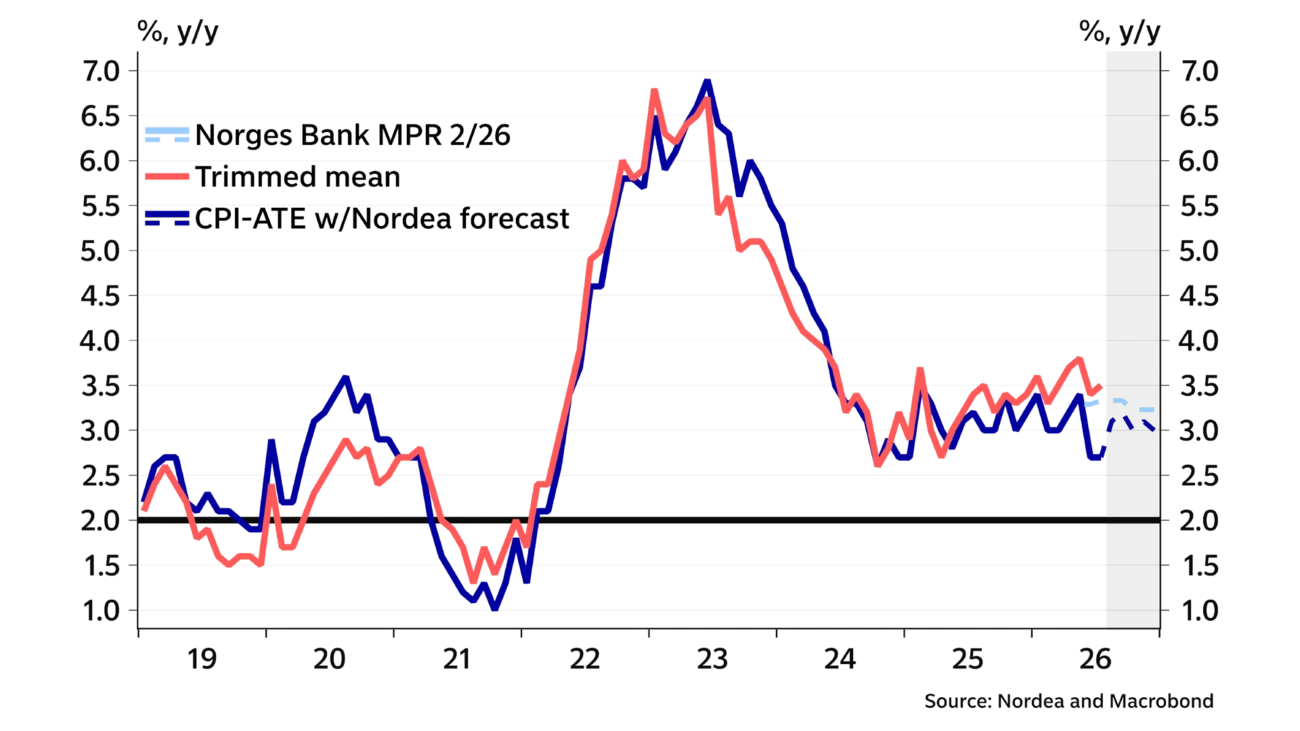
Core inflation fell unexpectedly during the summer months and has been clearly below Norges Bank’s projections (see chart B /). We do not think Norges Bank is ready to relax yet, however. First, other measures of underlying inflation, such as the trimmed mean, show no sign of declining and have instead remained around 3.5%. There is also reason to expect CPI inflation adjusted for taxes and energy (CPI-ATE) to pick up again and remain around or just above 3% through year-end. In August last year, kindergarten fees were cut by about 40%, lowering inflation by around 0.4 percentage point. As fees are unchanged this year, year-on-year CPI inflation will, all else equal, jump again this August.
Norges Bank is not there yet.
Inflation has been clearly above the 2% target for almost five years. If our forecasts prove correct, there will have been no progress in bringing inflation down over the past two years. Instead, inflation appears to have stabilised around 3%. Persistently high wage growth has been an obvious driver.
Our reading of Norges Bank is that it is now more focused on bringing inflation down and therefore more willing to accept weaker growth and higher unemployment. That should help slow wage growth. Together with the stronger krone, this should lower inflation, although returning to 2% will take time.
Although summer inflation data have increased uncertainty about underlying price pressures, we still expect Norges Bank to raise the policy rate once more this autumn. Last year showed that declaring victory too early can be costly, so this time the Bank will likely want to be confident inflation is returning to target before easing again. We therefore expect no rate cuts before 2028, and then only to 4%; probably not far from a new normal for the policy rate.
Get the economic outlook for Norway directly from our economists in this on-demand webinar (in Norwegian).
See the webinar


Economic Outlook
Global growth has continued to be robust and is benefitting from rapid technological development, which is boosting fixed asset investment.
Read more
Economic Outlook
US technology stocks have delivered very strong returns in recent years, both in absolute terms and relative to other markets. This has contributed to a strong dollar. However, the path to profitability for AI-related companies remains unclear. A sharp decline in the US equity market could lead to a significantly weaker dollar.
Read more
Economic Outlook
The global economy is demonstrating remarkable resilience in the face of geopolitical conflict, elevated energy prices and trade tensions. The US dollar is depreciating, while the Nordic economies continue to outperform.
Read more
Stay ahead of the curve with our expert economic insights and forecasts. Get the latest analysis on global and Nordic markets delivered straight to your inbox.
Read more
Economic Outlook
Finland’s long period of weak productivity growth finally appears to be easing. Part of the turnaround reflects a better cyclical backdrop, but the drivers of longer-term productivity growth have also strengthened.
Read more
Economic Outlook
The Finnish economy has grown broadly in the first half of the year. Growth has been seen in private consumption, investment and exports alike. We expect growth to continue despite higher fuel prices and interest rates caused by the Middle East crisis. The recovery is expected to pass through to the labour and housing markets with a lag.
Read more
Economic Outlook
Growth has picked up pace and economic conditions have normalised. The labour market is following suit, and with continued stable growth, resource utilisation will run slightly above normal next year.
Read more