More from the Economic Outlook
This article first appeared in the Nordea Economic Outlook: Resilience in motion, published on 2 September 2026.
Read more from the latest reportDenne siden findes ikke på norsk
Bli værende på denne siden | Fortsett til en lignende side på norskGrowth has picked up pace and economic conditions have normalised. The labour market is following suit, and with continued stable growth, resource utilisation will run slightly above normal next year.

Resource utilisation in the economy is close to balance. It is usually described as the difference between the actual level of output and a level that is sustainable in the long run (potential GDP), when labour and capital are fully utilised, and that is also consistent with durably stable price and wage developments. Resource utilisation cannot be observed directly, it is an assessment based on a range of indicators. It is uncertain, may differ across forecasters and is often revised. Resource utilisation has implications for the design of both monetary and fiscal policy.
The labour market is improving, but with a lag.
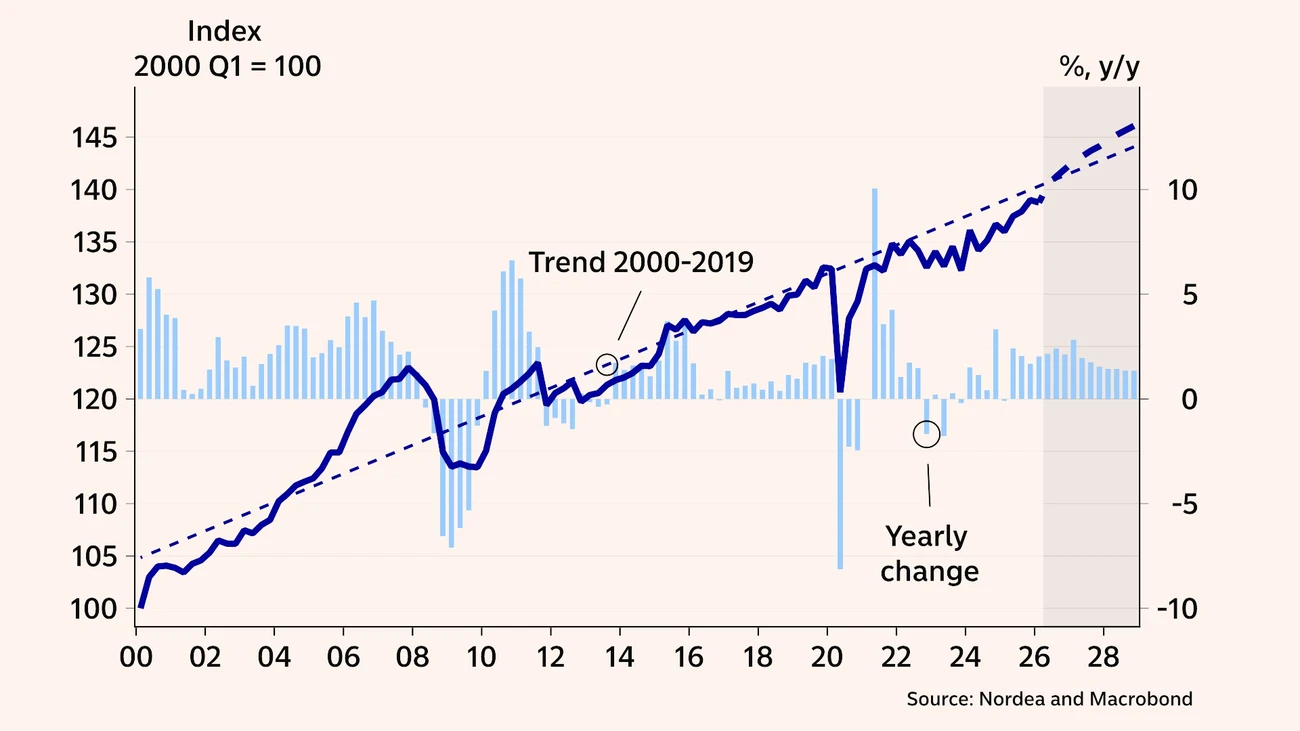
Potential GDP is determined by labour supply and productivity. Productivity growth has been strong over the past two years. Productivity usually rises in an economic upturn, as companies increase production using existing resources before they hire. Therefore, the labour market recovery occurs with some lag. Population growth has slowed, dampening labour supply and, hence, economic growth ahead. GDP per capita has returned to trend, while demand indicators have recovered to levels close to normal. Overall, economic conditions are now close to balance.
Unemployment is one indicator of spare capacity, but by no means the only one. It needs to be considered alongside other measures. Labour supply in terms of hours varies, for example, between students seeking part-time work and people seeking full-time employment. Unemployment has declined somewhat but remains elevated, even excluding students.
At the same time, there is spare capacity among employed people who are willing and able to work more. The share of underemployed workers is above its historical average, while hours worked per employed person are lower. Labour shortage indicators also remain somewhat below normal.
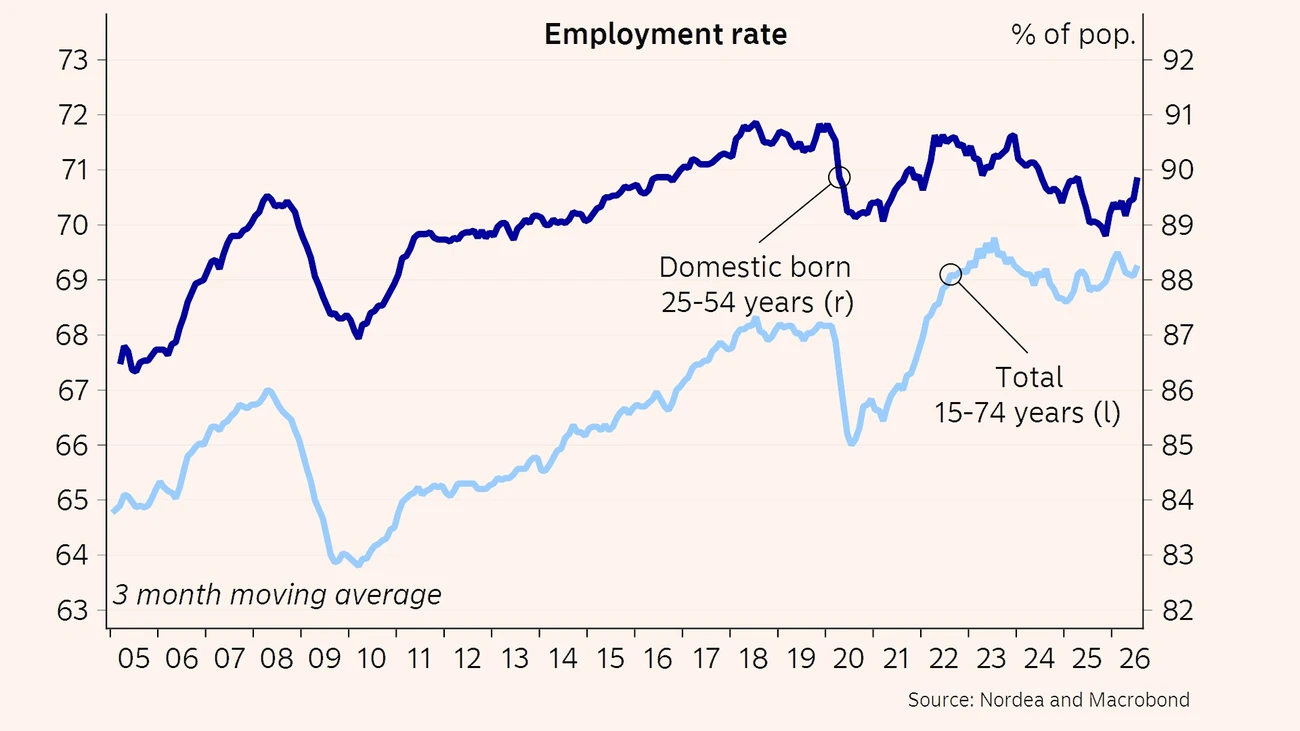
The employment rate is historically high, but this partly reflects structural changes. The labour supply has increased, for example among older and foreign-born, and a higher employment rate therefore does not necessarily imply a tighter labour market. Among native-born aged 25–54, where labour force participation has been relatively stable in recent years, the employment rate has declined but is now recovering. Overall, resource utilisation in the labour market is assessed to be gradually increasing, although spare capacity remains at present.
GDP has returned to trend and the recession is behind us. The growth outlook remains favourable, and the resource utilisation will run slightly above normal next year. Higher resource utilisation means that the Riksbank will normalise the policy rate to 2.25%. In the longer term, growth will slow to about 1.75% per year due to weaker population growth.
This article first appeared in the Nordea Economic Outlook: Resilience in motion, published on 2 September 2026.
Read more from the latest report
Stay ahead of the curve with our expert economic insights and forecasts. Get the latest analysis on global and Nordic markets delivered straight to your inbox.
Read more
Teknologinen kehitys on pystynyt kompensoimaan geopoliittisen epävarmuuden negatiiviset vaikutukset talouteen, ja maailman kasvuvauhti on säilynyt ripeänä.
Read more
Economic Outlook
Finland’s long period of weak productivity growth finally appears to be easing. Part of the turnaround reflects a better cyclical backdrop, but the drivers of longer-term productivity growth have also strengthened.
Read more
Economic Outlook
The Finnish economy has grown broadly in the first half of the year. Growth has been seen in private consumption, investment and exports alike. We expect growth to continue despite higher fuel prices and interest rates caused by the Middle East crisis. The recovery is expected to pass through to the labour and housing markets with a lag.
Read more